Last updated 2026-07-11
TL;DR
You can build phonics games at home with index cards, dice, shaving cream, and sandpaper. Kids with dyslexia learn fastest through multisensory practice that pairs sound, sight, and touch at once. Every game here costs under two dollars and targets a skill from structured literacy research. No training required, no subscription, no laminator.
Why do homemade phonics games actually work for kids with dyslexia?
Kids with dyslexia have trouble mapping printed letters to their sounds, a process reading researchers call phoneme-grapheme correspondence [1]. Their brains handle print differently. That difference does not mean they can't learn to read. It means they need more repetition, stronger sensory input, and a teaching order that moves step by step.
The research on what helps is solid. The National Reading Panel's 2000 report found that systematic, explicit phonics instruction produced significant gains in reading accuracy across students, and the effect was strongest for children with reading disabilities [2]. Games built on that same logic, sound by sound and pattern by pattern, deliver the repetition without the grind of worksheets.
Something else happens when a child is laughing, rolling dice, or squishing letters into clay. Their stress drops. Anxiety is a real wall for kids who've been called slow or lazy, and a game takes that weight off. You're not drilling. You're playing. That shift matters more than most parents expect.
The games below are not random crafts. Each one hits a specific skill from the structured literacy progression: phonemic awareness, letter-sound knowledge, blending, segmenting, then vowel patterns and multisyllabic words. Work through them roughly in that order.
What materials do you need to make phonics games at home?
Almost nothing. Here's what the games in this article need, with typical costs:
| Material | Where to get it | Approx. cost |
|---|---|---|
| Index cards (100-pack) | Dollar store | $1 |
| Permanent marker | Dollar store | $1 |
| Dice (set of 6) | Dollar store or old board game | $1 |
| Sandpaper sheets (fine grit) | Hardware store remnants | $0-$2 |
| Shaving cream | Dollar store | $1 |
| Playdough or air-dry clay | Homemade (flour, salt, water) | $0 |
| Small smooth pebbles or wooden discs | Craft store or outside | $0-$2 |
| Egg carton | Recycled | $0 |
| Sticky notes | Dollar store | $1 |
Total maximum spend lands around $10, and most families already own half of it. No laminator, no color printer, no paid app.
One thing worth buying if you don't have it: a set of foam or magnetic letters. A full set runs $5 to $8 at most dollar or discount stores and makes a dozen games possible. It's the single best low-cost buy for a child working on letter-sound connections.
What are the best DIY phonics games for beginning readers with dyslexia?
Start here if your child is still shaky on single letter sounds or can't yet blend a three-letter word.
Sandpaper letter tracing cards Cut sandpaper into small squares. Write one letter on each in large print, going over each stroke several times so the texture rises a little. Have your child trace the letter with two fingers while saying its sound out loud. This is a classic Montessori move with real multisensory backing. Touch and sound together build a stronger memory trace than seeing alone [3]. Make 26 cards for consonants and short vowels. Later, add digraph cards for ch, sh, th, wh.
Sound boxes (Elkonin boxes) Draw three or four connected squares on an index card. Say a word, for example "cat." Your child pushes a pebble or penny into each box as they say each sound: /k/, /ae/, /t/. This builds phonemic segmenting, the skill of pulling a spoken word apart into its sounds. Segmenting is one of the strongest predictors of early reading success [2]. You can make 20 of these cards in ten minutes.
Letter-sound bingo Draw a 4x4 grid on cardstock. Fill each square with a letter or digraph. Call out sounds, not letter names: "Find the letter that says /sh/." Your child covers the match with a pebble. Four in a row wins. This works for two to four players, so siblings can join.
"I spy" sound bags Fill a paper bag with small objects whose names start with a target sound: a button, a bean, a block for /b/. Pull one out. Say its name. Ask what sound it starts with. Then connect that sound to the letter on a card. The physical object makes the word concrete, which helps kids who struggle with abstract symbol matching.
Which DIY games help with blending and decoding short vowel words?
Once a child knows most letter sounds, the bottleneck moves to blending: holding sounds in working memory long enough to fuse them into a word. These games drill that.
Slide-and-read word strips Cut index cards into strips about 8 inches long. Write a consonant on the left, a vowel in the middle, a consonant on the right (a CVC word: c-a-t). Cut a separate small card with just the first consonant. Slot it through a slit in the left side of the strip so you can slide it in and out. Swap the initial consonant: cat, bat, hat, mat, sat. The sliding motion slows your child down in a good way and makes each new word feel like a discovery.
Word family flip books Stack three index cards and staple them on one side. On the top card, write the ending chunk (-at, -an, -ig). On each flipped page, write a different beginning consonant. Flip through to make sat, bat, cat, fat, hat, mat, pat, rat. Kids with dyslexia often do better when the word ending stays put and they swap only the onset. It cuts working memory load.
Dice blending game Label one die with consonants: b, c, d, f, g, h. Label a second die with short vowel chunks: -at, -en, -ig, -op, -un, -ed. Roll both and read the combination. Some rolls make real words, some don't, and deciding which is which is half the fun. This takes about three minutes to make and most kids will play it for twenty straight.
Shaving cream letter writing Spray a thin layer of shaving cream on a cookie sheet or table (it wipes clean). Call out a word. Your child writes it in the cream, letter by letter, sounding out each phoneme. The tactile feedback is strong and the impermanence keeps pressure low. Wrong answer? They swipe and try again. Research on multisensory writing shows the motor-tactile loop reinforces letter-sound memory for students with dyslexia [3].
How do you make phonics games that cover vowel teams and long vowel patterns?
Many kids with dyslexia stall around first or second grade phonics because they hit vowel teams (ai, ea, oa, ue) and the rules feel random. These games help.
Vowel team sorting mats Make two columns on cardstock: "short vowel" and "long vowel." Write words on index cards: cape, cap, bite, bit, hope, hop. Shuffle and have your child sort them into the right column. This builds pattern awareness. As they advance, add columns for specific teams: ai/ay, ee/ea, oa, oe.
Vowel pattern war (card game) Write words on index cards, one per card, covering several vowel patterns. Deal them evenly between two players. Both flip a card at the same time. Whoever reads both correctly wins the pair. Ties trigger a "war" round of three cards. The familiar war format means no new rules to explain.
Highlight-the-vowel-team game Write several sentences on paper with words that contain vowel teams. Hand your child a yellow crayon or highlighter. Their job: find and mark every vowel team before reading the sentence aloud. This slows the scan and trains the eye to spot multi-letter patterns instead of processing one letter at a time, which is where many struggling decoders get stuck.
Pair these games with explicit teaching first. The game is practice, not the introduction. If your child doesn't already know that "ai" usually says long a, the game just breeds guessing. Five minutes of direct explanation before you play keeps the practice accurate.
Are there multisensory phonics games that help with letter reversals?
Letter reversals, especially b and d, top the complaint list for parents of kids with dyslexia. Worth knowing: reversal errors are common in all children up to about age 7 [4]. After that, persistent reversals usually point to a deeper issue with letter orientation memory.
Bed trick card Write the word "bed" in lowercase on an index card, big enough that the b forms the headboard on the left and the d forms the footboard on the right. When your child can't remember which way b or d faces, they look at the card and picture a bed. This mnemonic has floated around special education classrooms for decades. It's simple and it works for a lot of kids.
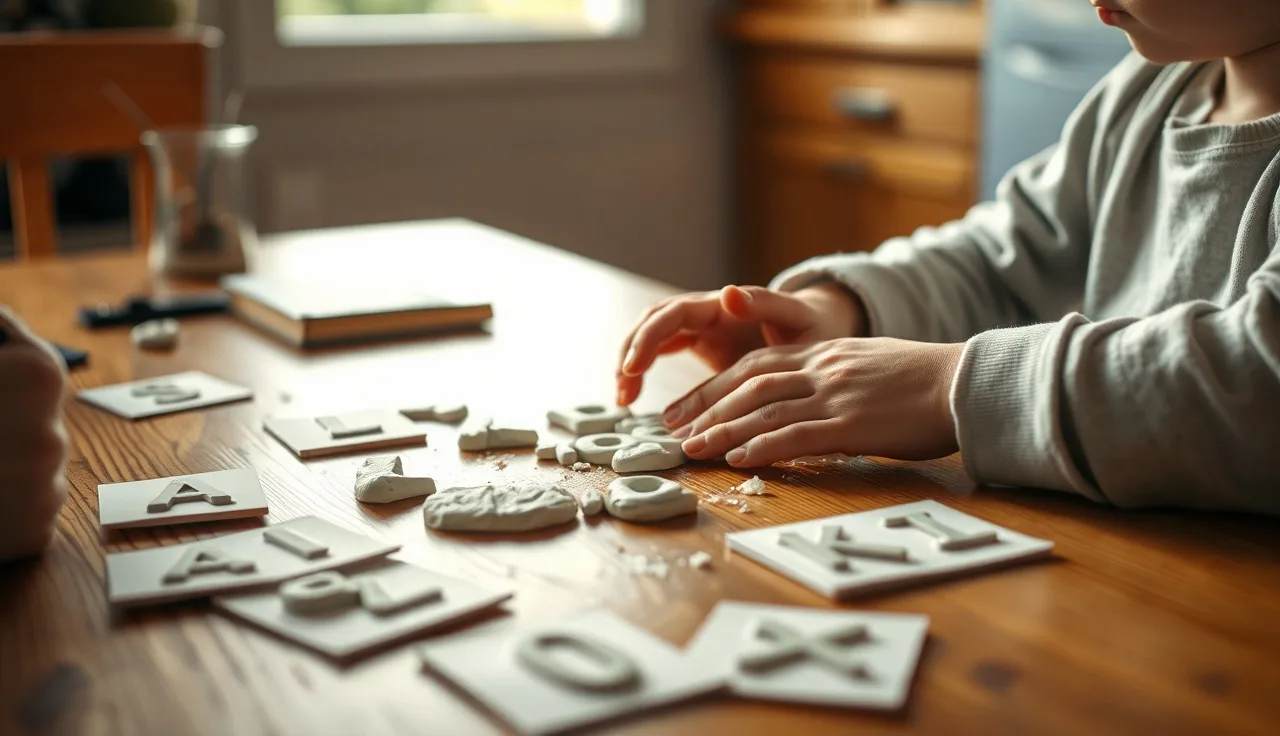
Clay letter sculpting Roll out playdough or air-dry clay. Ask your child to build the letter b: straight line first, then the bump to the right. Then build d: straight line first, bump to the left. Constructing the letter from its parts builds a spatial memory that visual drills alone often miss.
Arm trick for b and d Hold both fists in front of you, thumbs up. The left hand makes a lowercase b, the right hand a lowercase d. It's a body-based anchor. Teach your child to hold up their fists whenever they're unsure. Over several weeks, they'll drop it on their own.
None of these tricks replace systematic phonics instruction. They hand a child a self-rescue move when they hit a wall mid-read.
What DIY games help a child with dyslexia practice sight words?
A lot of common sight words ("the," "said," "was") can't be fully decoded by phonics rules because their spelling is irregular. Kids with dyslexia struggle to memorize these because they lean on the visual memory route, which is weaker for them. Pairing sight with sound and meaning helps.
Tap-and-spell sight word cards Write one sight word per index card in large letters. Hold up the card. Your child reads it aloud, taps each letter while spelling it out ("t-h-e"), then reads it again in a sentence. Three exposures in thirty seconds: seeing, touching and spelling, using it. This is the word study routine used in programs like Wilson Reading and Orton-Gillingham.
Sight word memory match Make two identical sets of 10 sight word cards. Turn them all face down. Players flip two cards per turn. A match means the player reads the word aloud and keeps the pair. The matching rule forces repeated exposure across the whole game.
Sight word hopscotch Write sight words in chalk squares on the sidewalk, or use sticky notes on the floor indoors. Call out a word. Your child hops to it. Movement plus word retrieval is a whole-body approach that many kids with dyslexia respond to hard.
Some parents start with Dolch sight words as their game list. The Dolch list of 220 words makes up roughly 50 to 75 percent of the words children meet in early reading texts [9], so they're worth the repetition.
How do you sequence these games so you're more than playing randomly?
Random phonics practice beats nothing, but a logical sequence gets you faster gains. Here's the order that matches the structured literacy scope-and-sequence most reading researchers and clinicians agree on [5]:
1. Phonemic awareness first: sound boxes, sound bags, "I spy" games. No letters yet, just sounds. 2. Letter-sound knowledge: sandpaper cards, letter-sound bingo. Teach consonants and short vowels. 3. Blending CVC words: slide-and-read strips, word family flip books, dice blending. 4. Consonant blends and digraphs (bl, cr, sh, th): same game formats, new cards. 5. Long vowel patterns: vowel sorting mats, vowel team war. 6. Multisyllabic words: split words into syllables on separate index card halves that have to be physically assembled.
Aim for 10 to 15 minutes of game-based phonics daily. That's the sweet spot. Enough repetition to build automaticity, short enough to keep attention and goodwill. More than 20 minutes of direct phonics work usually brings diminishing returns and sometimes flat refusal.
If your child gets services at school under an IEP or 504 plan, ask the reading specialist what phonics level your child works at right now. Then match your home games to that level exactly. You want school and home practice reinforcing the same patterns, not fighting each other.
Should you tell your child these games are for their dyslexia?
This depends on age and self-awareness. Most kids who've been through reading assessments already sense something is different about how they read. Hiding it can feel dishonest, and it robs them of the language to speak up for themselves.
What beats hiding: normalize it. Try something like, "Your brain learns sounds differently than some other kids, and these games are built for exactly how your brain works." That framing is accurate and kind. Dyslexia is a difference in phonological processing, not an intelligence problem [1]. Kids who grasp this tend to stay more motivated and less ashamed.
If your child has never been formally assessed and you're unsure whether dyslexia is in play, a school evaluation or a private dyslexia test gives you a clear picture. Knowing the specific weakness (phonological awareness, rapid naming, working memory) lets you target games more precisely.
And if the school isn't providing decent reading support, know your rights. Under IDEA (Individuals with Disabilities Education Act, 20 U.S.C. § 1400 et seq.), schools must identify children with specific learning disabilities and provide free appropriate public education [6]. If your child qualifies, an IEP or 504 plan can require evidence-based reading instruction and accommodations. These games add to school support. They don't stand in for the specialized instruction a child with dyslexia may be entitled to.
How do you keep a child with dyslexia motivated to play phonics games?
Motivation collapses fast when a child fails too much. The most practical rule: keep your child around 80 percent accuracy during play. If they're missing more than two out of ten words, the material is too hard. Back up a level. If they're acing everything with no effort, it's too easy, and boredom moves in.
Build in a choice whenever you can. "Do you want the dice game or the flip book tonight?" Kids who feel some control over practice stick with it longer.
Celebrate wins with specifics. Not "good job," which lands empty, but "you just read 'ship' with no help, and three weeks ago that was really hard for you." Praise tied to real progress sticks.
Rotate games every week or two. Everything here can be remade with new words. The shaving cream game is still fresh the 20th time if the words are new. The dice game changes every roll.
Some families use a simple progress chart, 20 words drawn in a grid and colored in one by one as mastered. It doesn't need to be fancy. A sheet of paper and a marker works. For parents who want ready-made trackers and word lists, the ReadFlare free reading toolkit has printable phonics progress charts you can download and use alongside these games.
Know when to stop. If a session slides into tears or frustration, end it early and don't make it a thing. Say, "We got through four rounds, that's great. Same time tomorrow." Short, warm, and consistent beats long and painful every time.
What does the research say about games vs. formal phonics programs for dyslexia?
Here's the honest answer: no large randomized controlled trials compare DIY games head to head against programs like Wilson Reading System or Barton. The research that exists compares structured literacy programs against typical classroom instruction, and structured literacy wins clearly and consistently [5].
What the adjacent research tells us: multisensory instruction (touch plus sound plus sight together) works better for students with dyslexia than single-modality drill [3]. Phonemic awareness practice at home produces measurable decoding gains when it follows the same logic as school instruction [10]. And frequency matters. Children need to meet a new sound-spelling pattern roughly 30 to 40 times before it turns automatic [10], far more repetition than a classroom can deliver in a week.
So games don't replace a structured literacy program. They create the volume of repetition that even a good program can't supply alone. Picture it this way: a certified reading specialist working with your child twice a week gives maybe 80 minutes of phonics instruction weekly. Add 70 minutes of targeted game play at home (10 minutes a day) and you've nearly doubled the exposure. That math matters.
The catch: the games have to hit the right skills in the right order. Random letter games that ignore phonics logic won't produce the same result. That's why the sequencing section above carries as much weight as the game ideas.
Parents who want to align home practice with school support will find the parent advocacy kit on ReadFlare useful for shaping conversations with teachers and reading specialists. Everything in this article stands on its own without it.
What school rights does your child have if phonics games at home aren't enough?
Home practice fills gaps. It doesn't replace what schools are legally required to provide.
Under IDEA, 20 U.S.C. § 1400 et seq., schools must evaluate any child suspected of having a disability, including a specific learning disability in reading, at no cost to the parent [6]. If the evaluation confirms a disability, the school must write an Individualized Education Program (IEP) with specially designed instruction. You can request this evaluation in writing at any time.
The U.S. Department of Education has clarified that dyslexia is a specific learning disability covered under IDEA and Section 504 of the Rehabilitation Act [7]. The department's 2015 guidance stated plainly that there is nothing in IDEA that would prohibit the use of the terms dyslexia, dyscalculia, and dysgraphia in IDEA evaluation, eligibility, and IEP documents. Schools must provide evidence-based reading intervention, more than more time on the same instruction that isn't working.
Section 504 of the Rehabilitation Act (29 U.S.C. § 794) covers students who don't qualify for an IEP but still have a disability that substantially limits a major life activity. Reading is a major life activity. A 504 plan for school can require accommodations like extended time, audiobooks, or preferential seating without changing the curriculum [8].
Unsure which pathway fits your child? The comparison between an IEP vs 504 is worth understanding before your next school meeting. The legal thresholds differ, and so do the services available under each.
The Department of Education's Office for Civil Rights enforces Section 504 and the ADA in schools. Their complaint process is free and does not require a lawyer [8].
Frequently asked questions
What is the easiest phonics game to make for a child with dyslexia tonight?
Sound boxes take five minutes. Draw three connected squares on an index card. Say a three-letter word like "hat" and have your child push a penny into each box while saying each sound separately: /h/, /ae/, /t/. Make five cards tonight for five different words. This builds phonemic segmenting, one of the strongest predictors of early reading success according to the National Reading Panel's 2000 report.
Do homemade phonics games actually work or are they just fun activities?
They work when they target the right skills in the right order. The National Reading Panel found systematic, explicit phonics instruction produces significant improvements for struggling readers, and multisensory practice reinforces learning better than single-modality drill. Games that follow the structured literacy sequence (phonemic awareness first, then letter sounds, then blending, then vowel patterns) produce real decoding gains. Random craft activities with letters don't.
How much time should I spend doing phonics games with my child each day?
Ten to fifteen minutes daily is the research-supported sweet spot. It gives enough repetition for new sound-spelling patterns to become automatic (children typically need 30 to 40 exposures) without draining attention or goodwill. More than 20 minutes of direct phonics work usually brings diminishing returns for children with dyslexia. Short daily sessions beat long weekly ones every time.
My child reverses b and d constantly. Which game helps most?
The "bed" card mnemonic is the most practical tool. Write "bed" in lowercase on an index card so the b forms the headboard and the d the footboard. When your child is unsure, they picture the word bed. Clay letter sculpting also helps: building each letter from a vertical line plus a bump reinforces the spatial difference. Reversals that persist past age 7 can signal a phonological memory issue worth raising with a reading specialist.
Can I use these games if my child is already getting help from a reading specialist at school?
Yes, and they work best when you match home games to whatever phonics level the specialist teaches. Ask which patterns your child is working on this week, then build or pick games that practice those exact patterns. You're adding volume of repetition, not competing material. A child getting 80 minutes of specialist instruction per week plus 70 minutes of home game play nearly doubles their weekly phonics exposure.
What phonics games help with vowel teams like ai, ea, and oa?
Vowel team sorting mats work well. Write words on index cards and have your child sort them by vowel pattern into labeled columns. Vowel pattern war, a card game where players race to read two flipped cards correctly, builds automaticity. Always teach the pattern explicitly before the game. If your child doesn't know that ai usually says long a, the game produces guessing instead of learning.
Is dyslexia a learning disability covered under federal education law?
Yes. The U.S. Department of Education confirmed in 2015 guidance that dyslexia is a specific learning disability covered under IDEA (20 U.S.C. § 1400 et seq.) and Section 504 of the Rehabilitation Act. Schools must evaluate children suspected of having dyslexia at no cost to parents, can use the word dyslexia in documents, and must provide evidence-based reading instruction when a disability is identified. A written evaluation request starts the process.
What is the difference between an IEP and a 504 plan for a child with dyslexia?
An IEP under IDEA provides specially designed instruction and services, meaning the school changes how they teach your child. A 504 plan under the Rehabilitation Act provides accommodations like extended time or audiobooks but doesn't require changes to instruction itself. IEP eligibility requires the disability to adversely affect educational performance. 504 eligibility requires it to substantially limit a major life activity. Reading qualifies under both.
Are there phonics games that work for older kids with dyslexia, more than beginners?
Yes. The formats scale up. Use vowel pattern war with multisyllabic words. Make syllable assembly cards where a word like "fantastic" splits into three index card halves that must be read and assembled correctly. The dice blending game can use tougher rimes like -ight, -ough, -tion. The same multisensory logic, pairing touch, sound, and sight, applies at every level of phonics.
Can shaving cream games really help with phonics or is that just a sensory activity?
The sensory part is why it helps. Research on multisensory learning shows that combining tactile input with auditory and visual processing builds stronger memory traces for letter-sound patterns in students with dyslexia. Writing letters and words in shaving cream while sounding them out engages the motor-tactile loop that standard paper writing also uses, but with lower stakes and more novelty. The impermanence cuts anxiety, a real barrier for many struggling readers.
How do I know which phonics level to target in these games?
If your child has a school evaluation, it lists phonics skill levels. If not, run a quick informal check: ask your child to read a list of CVC words (cat, him, fox), then consonant blend words (slip, frog), then long vowel words (cape, kite). Find the level where accuracy drops below about 80 percent. That's your starting point. A reading specialist or the school's resource teacher can give a more precise placement if you ask.
What if my child refuses to play phonics games at home?
Choice helps most. Offer two games and let them pick. Keep sessions short, ten minutes max at first, and stop before frustration hits. Check that the material sits at the right level: too hard and kids shut down, too easy and they're bored. If refusal is strong and steady, it often means the child links reading practice with failure and shame. A talk with a school counselor or psychologist can help alongside adjusting the difficulty.
Do font choices matter for kids with dyslexia doing phonics games?
The evidence on specialized dyslexia fonts is mixed. No font has been shown to significantly improve reading speed or accuracy in peer-reviewed research. Still, using clear, widely spaced print (like Arial) when you handwrite game cards is sensible. Avoid all-caps and italic text for struggling readers. If you're curious what the studies actually show, the breakdown is covered in the article on dyslexia font on ReadFlare.
Are Dolch sight words still recommended for children with dyslexia?
Dolch words are a practical target list because they make up a large share of early reading text, roughly 50 to 75 percent by some estimates. For kids with dyslexia, teach phonetically regular Dolch words through decoding and save pure memorization for truly irregular words like 'said' or 'the.' Multisensory tap-and-spell routines beat flashcard drilling alone and improve retention for this group.
Sources
- Yale Center for Dyslexia and Creativity, 'What is Dyslexia?': Dyslexia involves difficulty mapping printed letters to sounds (phoneme-grapheme correspondence) and reflects a difference in phonological processing, not intelligence.
- National Institute of Child Health and Human Development, 'Report of the National Reading Panel' (2000): Systematic, explicit phonics instruction produced significant improvements in reading accuracy, with especially strong effects for children with reading disabilities; phonemic segmenting is a strong predictor of early reading success.
- International Dyslexia Association, 'Multisensory Structured Language Teaching': Multisensory instruction combining touch, sound, and sight creates stronger memory traces for letter-sound patterns and is more effective for students with dyslexia than single-modality drill.
- American Academy of Pediatrics, 'Learning Disabilities in Children' (HealthyChildren.org): Letter reversals are common in all children up to approximately age 7; persistent reversals after that age may signal a phonological memory issue.
- What Works Clearinghouse, Institute of Education Sciences (IES): Structured literacy programs following a systematic scope-and-sequence significantly outperform typical classroom reading instruction for students with reading disabilities.
- Individuals with Disabilities Education Act (IDEA), 20 U.S.C. § 1400 et seq., ED.gov: Under IDEA, schools must identify children with specific learning disabilities and provide free appropriate public education, including evaluation at no cost to parents.
- U.S. Department of Education, Office of Special Education Programs, 'Dear Colleague Letter on Dyslexia' (October 2015): The U.S. Department of Education confirmed dyslexia is a specific learning disability under IDEA and Section 504, and that IDEA does not prohibit using the terms dyslexia, dyscalculia, and dysgraphia in evaluation, eligibility, and IEP documents.
- Section 504 of the Rehabilitation Act, 29 U.S.C. § 794, U.S. Department of Education Office for Civil Rights: Section 504 covers students with a disability that substantially limits a major life activity, including reading; schools must provide accommodations and the OCR complaint process is free.
- Dolch, E.W. (1936), 'A Basic Sight Vocabulary,' Elementary School Journal, 36(6), 456-460; cited by Florida Center for Reading Research: The Dolch 220-word list accounts for approximately 50 to 75 percent of words children encounter in early reading texts.
- Florida Center for Reading Research (FCRR), Florida State University: Phonemic awareness training at home following the structured literacy sequence produces measurable gains in decoding; children need approximately 30 to 40 exposures for a new sound-spelling pattern to become automatic.