Last updated 2026-07-09
TL;DR
Sight word bingo is a bingo-style game where kids mark words on a card as a caller reads them aloud, building fast recognition of high-frequency words. It works best as review after phonics instruction, not as the main way to teach reading. Make cards by hand, print free versions, or use ABCya's digital game. Struggling readers may need 30 or more exposures to a word before it sticks.
What is sight word bingo and how does it work?
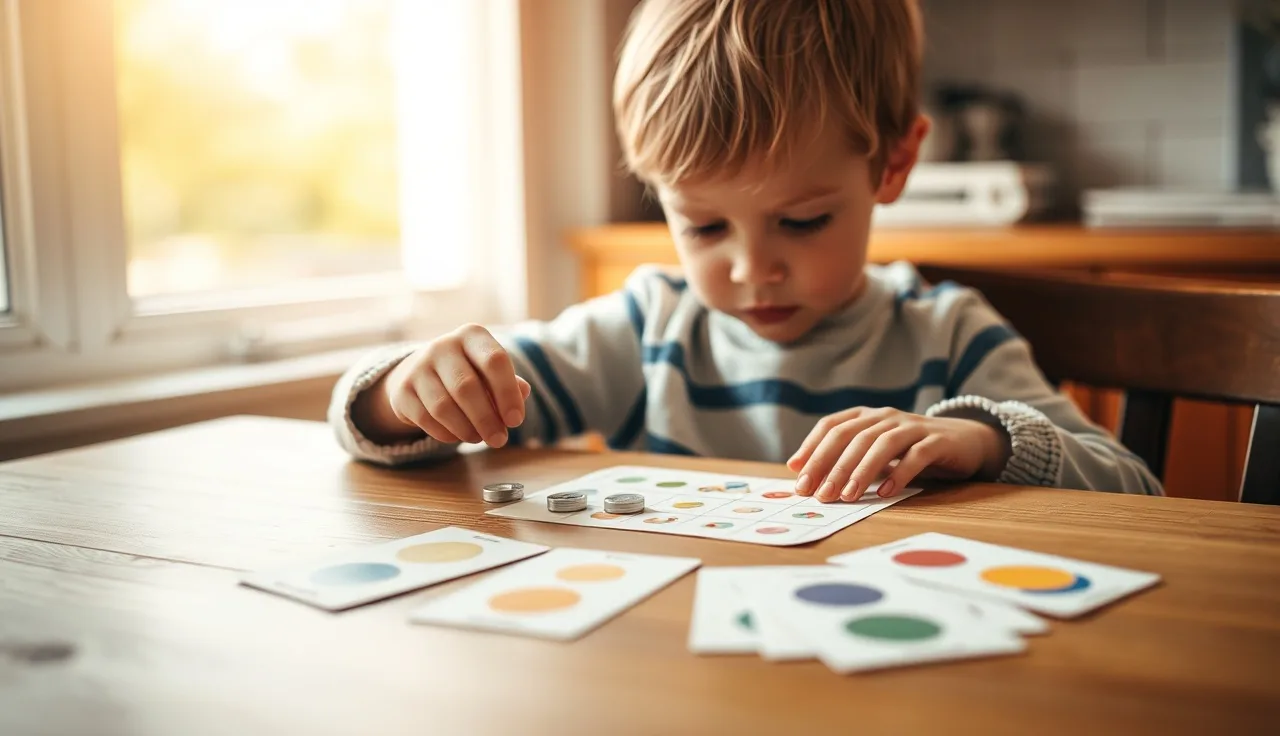
Sight word bingo is a bingo-format game where each player's card holds high-frequency words instead of numbers. A caller reads a word aloud. Players hunt for it and mark it. First to complete a row, column, or diagonal calls bingo and wins.
You can run it with two people or thirty. You need one card per player, a set of word cards for the caller to draw from, and markers of some kind. Pennies, dried beans, small tiles, sticky dots. All of them work.
Why bingo? Repetition, plus enough competition to keep kids interested without raising the stakes. A ten-minute round puts the same words in front of each child four to eight times. That lines up reasonably well with what the research says about how many exposures struggling readers need before a word becomes automatic. One estimate cited across teacher training puts that number at 30 to 40 exposures for students with reading difficulty, against 1 to 4 for typical readers, though those figures trace back to early studies that varied in method [1]. Bingo won't hit 40 reps in one sitting. But it's a painless way to stack them up over weeks.
Do sight words actually need to be memorized whole, or is there a better way?
There's a real argument in reading science here, and you should understand it before you pour hours into bingo games. The short version: whole-word memorization is the old model, and it's largely wrong for the words most kids struggle with.
The traditional view ran from roughly the 1950s through the 1990s. It treated sight words as words that couldn't be sounded out and had to be memorized by shape. That's the thinking behind the original Dolch list (1936) and the Fry list (1980s). Flashcards and bingo slot right into it.
The current view comes from Linnea Ehri's work on orthographic mapping. Words become "sight words" through a process that still runs on phonemic awareness and letter-sound knowledge [2]. The brain maps sounds to spellings, and once that mapping locks in, the word gets retrieved instantly. Under this model bingo still earns its place, because it adds exposures that reinforce stored mappings. But it works best after the child has had phonics instruction on the word's spelling patterns, not before.
For most kids, bingo as a warm-up or review game fits the science fine. For a child with dyslexia, memorizing words by shape with no phonics behind them tends to fail. If your child can't hold onto words no matter how many rounds you play, pay attention to that. The signs of dyslexia page has a checklist you can run through in ten minutes.
So here's the practical rule. Use sight word bingo to reinforce words your child is already learning through phonics. Don't use it as the teaching method itself.
Which sight word lists should you use for bingo?
Two lists run K-2 classrooms: Dolch and Fry. For a beginner's bingo game, either one works, and they overlap so much at the early levels that the choice barely matters.
The Dolch list has 220 service words plus 95 nouns, built by Edward Dolch in 1936 [11]. It's grouped by grade band: pre-primer, primer, first grade, second grade, third grade. The pre-primer set ("the," "a," "and," "I," "see") is where nearly every kindergarten bingo game starts. Our dolch sight words page has the full breakdown.
The Fry list has 1,000 words ranked by how often they appear in print, built by Edward Fry in the 1980s. The first 100 Fry words cover about 50 percent of everything in print, and the first 300 cover about 65 percent [3]. For bingo, the first 100 to 200 Fry words and the Dolch pre-primer through first-grade lists overlap heavily and swap in for each other with no trouble.
Here's a quick comparison:
| List | Total words | Grade bands | Best for |
|---|---|---|---|
| Dolch | 220 service + 95 nouns | Pre-K through 3rd | K-2 classroom games, IEP goals |
| Fry | 1,000 words | Grouped by hundreds | 2nd grade and up, broader coverage |
| School-specific | Varies | Varies | Matching exactly what the teacher sends home |
Keep each card to 24 or 25 words (a standard 5x5 grid with a free space). Pull from one grade-level set so the words sit at roughly the same difficulty and all fit where your child is right now. Mixing pre-primer words with third-grade words on a single card just frustrates a beginner.
For first grade in particular, our first grade sight words page lists which words most schools target by semester.
How do you make sight word bingo cards at home?
Making cards by hand is faster than it sounds. Draw a 5x5 grid on cardstock, write a different sight word in each square, mark the center as the free space, and make four or five unique cards by shuffling the word order between them. The caller's set is just those same words written on index cards or slips, drawn from a cup.
Want printables instead? Several free sources exist. Teachers Pay Teachers has dozens of free bingo sets sorted by Dolch and Fry level. Sightwords.com has free printable cards. ABCya (abcya.com) runs a digital sight word bingo game in a browser, handy if you want a solo option for a child with no sibling or parent free to call words.
A few things teachers who run these games actually do:
Print on cardstock, not copy paper. Copy paper warps after a few rounds.
Laminate if you can. A cheap laminator runs about $25 to $35, and laminated cards last for years.
Skip the physical markers on laminated cards and use a dry-erase marker instead. Resetting between rounds takes seconds.
Cap each session at 10 to 15 minutes for kids under 7. Their attention runs out well before the game does.
For printables that pair with the game, our sight words worksheets page sorts options by level.
What is ABCya sight word bingo and is it worth using?
ABCya (abcya.com) is a free educational games site aimed at K-5 students. Its sight word bingo game is a browser version where the computer calls words, highlights them on a virtual card, and tracks matches for you. A child can play it alone, no adult needed.
It's a reasonable tool for independent practice. You pick a grade level (K through 2), which lines up roughly with the Dolch bands. The interface is plain enough that most kindergarteners run it after one walkthrough.
Now the honest limits. Screen practice does less than a game that makes the child physically find and point to a word on a real card. Some reading research suggests physical interaction with text supports memory better than passive screen recognition, though nobody has clean studies comparing digital and print for bingo specifically. The bigger problem: ABCya's game gives no phonics context at all. The computer says a word, the child matches it by sight, and that's the whole loop. Fine for review. Teaches nothing new.
For a primary tool, sight word flashcards that pair words with letter-sound work beat it. ABCya bingo is better as a low-stakes way to close out a study session.
One practical note. ABCya shows ads next to its free games. The paid plan (around $4 to $6 per month as of mid-2025) removes them. For a kindergartener, mid-game ads pull attention hard enough that the subscription is worth a look if you plan to use the site often.
How many times does a child need to see a sight word before they remember it?
The number that shows up in teacher training is 4 to 14 exposures for a typical reader. Researchers who study this directly give wider ranges, because so much depends on what "knowing" a word means and how the exposures happened.
Ehri and colleagues found that children with strong phonemic awareness and letter knowledge could learn to read new words in as few as one to four trials, when the words came with a phonics component [2]. That's far below what the pure memorization model predicts.
For students with dyslexia or other reading difficulties, the picture shifts. These kids often need many more exposures, and the exposures need variety: saying the word, tracing the letters, hearing it in a sentence, seeing it in context, and yes, meeting it again in a review game like bingo. Maryanne Wolf's work on the reading brain describes how struggling readers don't build the automatic orthographic representations that fluent readers do, which can mean 30 or more deliberate practice encounters per word [4].
Bingo adds 1 to 3 exposures per word in a typical game. Not a lot. But it's consistent and low-effort, and kids ask to play it again. You can't say that about a worksheet.
If a child gets regular bingo practice and still can't hold common words after weeks, flag it to the teacher. A child who keeps relearning the same words without them sticking may need a formal reading evaluation. Our learning disability test page walks through what that looks like.
How does sight word bingo fit into a school's reading approach?
Most K-2 teachers use sight word games, bingo included, for practice and review, not for teaching. The actual instruction happens during whole-group or small-group reading, where the teacher introduces a word, explains its spelling pattern or its irregularity, uses it in context, and has children write it.
Bingo usually lives in learning centers (independent station work while the teacher meets with a reading group), as a Friday review game, or as a homework swap for worksheets. Plenty of schools send home printed bingo cards with the week's list so families can play.
If your child's school runs a structured literacy program, the approach reading science backs most strongly as of 2025 and one a growing number of states now require by law [5], bingo fits in as a fluency-building activity, not a core lesson. The Science of Reading consensus, laid out in the National Reading Panel's 2000 report and echoed by later Institute of Education Sciences practice guides, puts systematic phonics at the foundation with word recognition games as support [6].
Parents sometimes ask whether sight word bingo counts as "real" reading instruction for an IEP. It doesn't. If your child has an IEP with goals for reading fluency or sight word recognition, the specialized instruction written into that IEP is what carries legal weight. Bingo is supplemental. The school can't trade game time for the direct instruction your child is owed under IDEA. The statute (20 U.S.C. § 1414) says the IEP must include "a statement of the special education and related services... to be provided" and, to the extent practicable, based on peer-reviewed research [7].
To understand your child's full rights around reading instruction, the ReadFlare parent advocacy kit covers IEP meetings, evaluation rights, and how to ask for a specific reading intervention by name.
Can sight word bingo help kids with dyslexia?
It can help. With caveats that matter.
Dyslexia is mainly a phonological processing difficulty. The brain struggles to map sounds to letters reliably [8]. Because of that, any approach that asks a child to memorize whole words as visual shapes is the weakest option for dyslexia. A child with dyslexia can mark "the" correctly in bingo and still have no clue how to read it in a sentence the next morning, if the word was never taught by its structure.
Still, bingo isn't harmful, and it can be a genuinely good experience when it sits on a phonics foundation. Kids with dyslexia carry a lot of school-related anxiety and a running sense of failure. A game they can win, even partly, counts for something.
The strongest approach for dyslexia is structured literacy with multisensory methods, Orton-Gillingham based or similar. Inside that approach, review games like bingo work as part of a fluency-drill step, after words have been introduced and decoded explicitly. Some programs, Barton Reading and Spelling among them, build in exactly this kind of structured review.
For how dyslexia varies by subtype, the phonological dyslexia and surface dyslexia pages explain why the same game lands so differently for different kids.
If you suspect dyslexia and want to know what a formal evaluation involves, the dyslexia test page covers the process, what assessors look for, and how to request one through the school.
What are the best variations of sight word bingo for different ages and skill levels?
Standard bingo works for kindergarten through second grade. Below are variations worth knowing, matched to age and skill.
Pre-K and kindergarten (pre-primer words): Use 9-square cards (3x3) instead of 25. Fewer words means less frustration and a shorter game. Pair each call with a picture card showing the word in context. Words: a, and, away, big, blue, can, come, down, find.
First grade (primer and grade 1 words): Standard 5x5 cards work well. Have the caller use the word in a sentence after saying it: "The word is 'said.' She said hello to her friend." The sentence gives context that helps kids still building recognition.
Second grade and up (grade 2 and 3 words, or Fry 101-300): Raise the difficulty by having the caller give a definition or use the word in a sentence without naming it, so the child has to find it. Some teachers call this "mystery word bingo." It's harder, and older kids like it.
For kids with reading difficulty: Drop time pressure entirely. Let them keep sight word flashcards as a reference while they play. You're after exposure and positive association, not speed.
For groups with mixed skill levels: Make differentiated cards. Beginners get pre-primer words, stronger players get cards mixing grade 2 and grade 3. The caller says each word and uses it in a sentence. Everyone plays at once on different cards.
Digital variation: The ABCya sight word bingo game offers grade-level selection and runs on tablets, which makes it easier to differentiate in a classroom center without a teacher juggling several card decks.
What does research say about games versus flashcards for sight word learning?
Honest answer: the direct comparison evidence is thin. Most controlled studies of sight word acquisition use flashcard-style instruction as the baseline because it's easy to standardize. Games like bingo are hard to study cleanly, because too many variables shift from session to session.
What the research does support is distributed practice. Spreading exposures across multiple sessions beats cramming them into one long session [9]. Bingo fits that model when you play a short game several times a week instead of one marathon.
Spaced retrieval is the other relevant idea. Every time a child sees a word and pulls up its pronunciation, the memory trace strengthens. Bingo creates those retrieval events in a low-pressure setting, which functions much like the flashcard practice that does have solid backing.
A 2020 study in the Journal of Applied Behavior Analysis compared timed and untimed flashcard practice for sight word acquisition in elementary-age children. Both produced gains. Timed practice produced faster initial acquisition [10]. Bingo is untimed, so acquisition may run slower, but anxiety runs lower too, which matters for a child already stressed about reading.
The ReadFlare free reading tools include a sight word tracker you can run alongside bingo to log which words your child recognizes reliably and which still need work. Tracking matters because a game gives you no systematic record of where the gaps sit.
Bottom line: bingo isn't the most efficient tool for first learning a word. It's one of the most sustainable tools for review, because kids actually want to play it.
How do you know if sight word bingo is working?
You can measure word recognition at home. Two simple checks do the job.
First, run a cold read. Pull 20 words your child has been practicing and show each for about two seconds. Mark which get an immediate correct response (no sounding out, no long pause) and which take effort. Repeat every two to three weeks. The "immediate" column should grow.
Second, check for transfer. Can the child read those words in a book, more than in the game? This is the test that counts. Bingo practice that never shows up in connected text isn't doing enough.
If a child plays bingo regularly, nails the words in the game, but still trips on them while reading, the game context may sit too far from real text. Add a short sentence-reading step at the end of each round: write three or four sentences using that session's words and have the child read them aloud.
If a child makes no progress on retention after four to six weeks of consistent practice across several methods, that's a conversation with the teacher and possibly a formal reading assessment. Persistent trouble holding onto high-frequency words is one of the early signs worth investigating. Our signs of dyslexia page and learning disabilities overview cover what to watch for and what to ask the school.
Frequently asked questions
What sight words should I use for kindergarten bingo?
Use the Dolch pre-primer list: 40 words including 'the,' 'a,' 'and,' 'I,' 'see,' 'come,' 'look,' and 'big.' These show up most often in early readers. Cut the card to a 3x3 or 4x4 grid for very young children so the game finishes in 10 minutes or less. Match whatever your child's teacher currently sends home when you can.
Is ABCya sight word bingo free?
Yes. The basic ABCya sight word bingo game is free to play in a browser at abcya.com. The free version shows ads. ABCya offers a paid plan (roughly $4 to $6 per month as of mid-2025) that removes them. The game covers kindergarten through second-grade Dolch-aligned word sets and can be played solo, no adult caller needed.
How long should a sight word bingo session be?
Ten to fifteen minutes is the practical ceiling for children under 7. After that, attention drifts and the game stops helping. For older children, 20 to 25 minutes works if interest holds. Two short sessions across a day beat one long one, because spaced practice supports memory consolidation better than a single block.
Can sight word bingo count toward reading practice for an IEP?
Not as the primary intervention. Under IDEA (20 U.S.C. § 1414), a child's IEP must specify specialized instruction based on peer-reviewed research. Sight word bingo is a review game, not a structured literacy intervention. It can supplement IEP services but can't stand in for them. If a school uses games instead of the explicit instruction in your child's IEP, raise it directly.
How many sight words fit on a standard bingo card?
A standard 5x5 card has 25 squares. With a free center space, that's 24 different sight words per card. For younger children, a 4x4 card (15 words with a free space) is easier to manage. The caller's draw deck should hold every word used across all the player cards, so no card is left unable to win.
Do sight word games help kids who are behind in reading?
They help with review and motivation, but they don't replace systematic phonics for kids who are significantly behind. Research on struggling readers consistently shows explicit, structured phonics instruction produces the strongest gains. Games like bingo work best as practice after words have been taught directly, not as the main way new words get introduced.
What is the difference between Dolch and Fry sight words for bingo?
The Dolch list has 220 words across 5 grade levels from pre-primer through grade 3, plus 95 nouns. The Fry list has 1,000 words ranked by print frequency. For K-2 bingo, the lists overlap heavily. Dolch shows up more in school communication and IEP goals. Fry is more useful for grade 3 and up because it extends to more complex vocabulary.
Can I play sight word bingo with just two people?
Yes. One person calls the words and one plays a card. You can also have both play separate cards while trading off as caller, or one adult draws and calls while two children play against each other. Two players is actually a good ratio for kids who need more support, since the adult can respond the moment a child struggles with a word.
At what age should kids know all their sight words?
Most programs aim for children to recognize the Dolch pre-primer words reliably by the end of kindergarten, primer words by mid-first grade, and grade 1 and grade 2 words by the end of second grade. These are norms, not hard cutoffs. A child six months behind is worth monitoring; a child more than a year behind benefits from evaluation and targeted support.
What should I do if my child refuses to play sight word bingo?
Don't force it. Forced reading games backfire and raise anxiety around reading. Try a different format: Go Fish with sight word cards, sight word memory match, or building words with letter tiles. You want multiple low-stakes exposures to the same words. The specific activity matters less than the child's willingness to come back to it over time.
Are there sight word bingo games for older struggling readers?
Yes. Older students behind on sight word recognition can play the same game with age-appropriate framing: make it competitive, add a timer, or play for small rewards. Use Fry words 101-300 or school-specific vocabulary instead of cartoon-themed cards, which feel babyish to older kids. The mechanics hold up. The presentation has to respect the student's age.
How do I make sure the words my child practices in bingo match the ones used at school?
Ask the teacher for the current word list, which most K-2 teachers send home weekly or monthly. Build your cards from that list. This one step matters more than any other for making home practice work, because transfer is much stronger when the same words appear in school reading, bingo, and homework in the same week.
Sources
- Shaywitz, S. (2003). Overcoming Dyslexia. Vintage Books. (Number of exposures for struggling vs. typical readers, widely cited in teacher training literature): Struggling readers may need 30 to 40 exposures to a word compared to 1 to 4 for typically developing readers
- Ehri, L.C. (2005). Learning to Read Words: Theory, Findings, and Issues. Scientific Studies of Reading, 9(2), 167-188.: Words become sight words through orthographic mapping, a process that requires phonemic awareness and letter-sound knowledge, not whole-word visual memorization
- Fry, E. (1980). The New Instant Word List. The Reading Teacher, 34(3), 284-289.: The first 300 Fry words account for approximately 65 percent of all words encountered in print
- Wolf, M. (2007). Proust and the Squid: The Story and Science of the Reading Brain. Harper.: Struggling readers do not build automatic orthographic representations the way fluent readers do and may need 30 or more deliberate practice encounters with a word
- U.S. Department of Education, Office of Elementary and Secondary Education: State Literacy Plans: As of 2025, a growing number of states have passed laws requiring structured literacy or Science of Reading aligned instruction in public schools
- National Reading Panel (2000). Teaching Children to Read: An Evidence-Based Assessment. National Institute of Child Health and Human Development (NICHD).: Systematic phonics instruction is supported as the foundation for reading development; word recognition practice is supportive but supplemental
- Individuals with Disabilities Education Act, 20 U.S.C. § 1414 (IDEA): A child's IEP must include a statement of special education and related services to be provided based on peer-reviewed research to the extent practicable
- International Dyslexia Association: Definition of Dyslexia (adopted by NICHD): Dyslexia is a specific learning disability that is neurobiological in origin, characterized by difficulties with accurate and fluent word recognition and by poor spelling and decoding abilities resulting from a deficit in the phonological component of language
- Cepeda, N.J., Pashler, H., Vul, E., Wixted, J.T., & Rohrer, D. (2006). Distributed Practice in Verbal Recall Tasks: A Review and Quantitative Synthesis. Psychological Bulletin, 132(3), 354-380.: Distributed (spaced) practice across multiple sessions is more effective than massed practice in a single session for verbal recall tasks
- Marmolejo, E.K., et al. (2020). Comparison of Timed and Untimed Flashcard Practice for Sight Word Acquisition. Journal of Applied Behavior Analysis, 53(1).: Both timed and untimed flashcard practice produced sight word acquisition gains in elementary-age children; timed practice produced faster initial acquisition
- Dolch, E.W. (1936). A Basic Sight Vocabulary. The Elementary School Journal, 36(6), 456-460.: The Dolch list of 220 service words and 95 nouns was developed in 1936 and organized into grade-band levels from pre-primer through third grade
- Institute of Education Sciences, What Works Clearinghouse: Foundational Skills to Support Reading for Understanding in Kindergarten Through 3rd Grade (2016): IES practice guides support systematic phonics instruction as the primary approach with fluency-building activities as supplemental support for early reading