Last updated 2026-07-11
TL;DR
Tapping out words means touching one finger per sound (phoneme) while sounding out a word. The word "cat" gets three taps: /k/, /a/, /t/. It gives kids a physical anchor for sounds they can't easily hold in their head. Research on multisensory phonics shows it helps children with dyslexia and other decoding struggles. Five minutes a day is enough.
What does 'tapping out words' actually mean?
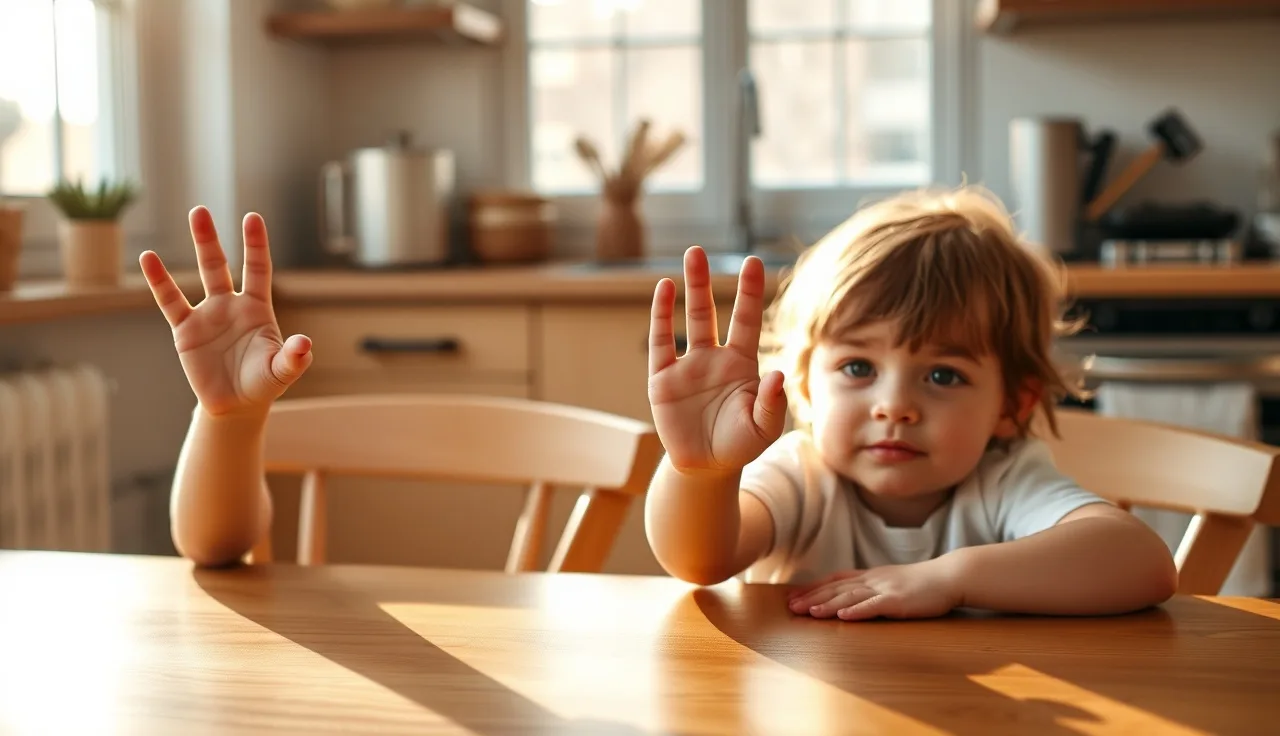
Tapping out words is a phonics move where a child touches a finger to their thumb (or a table, or their arm) once for each sound in a word. Reading teachers call those sounds phonemes. The word "cat" gets three taps: /k/, /a/, /t/. The word "ship" also gets three taps, because the letters "sh" make one sound together. After tapping each sound, the child slides their fingers together and blends the whole word aloud.
The physical touch is the whole point. Kids who can't hold sounds in working memory get a real, bodily anchor for each one. Instead of chasing four invisible sounds inside their head, they see four fingers. That tangible feedback is what makes the strategy stick.
Tapping is not clapping syllables, though people mix the two up constantly. Clapping syllables breaks "but-ter-fly" into three beats. Tapping phonemes breaks "butterfly" into nine separate sounds. Both skills matter. But phoneme-level tapping is the one tied most directly to reading and spelling words on a page [1].
You may hear it called "sound tapping," "phoneme tapping," or "Elkonin boxes" (a related paper version). The Orton-Gillingham approach uses a form of it. So do most structured literacy programs. The name changes; the core move never does. One finger, one sound, in order.
Why does tapping out words help struggling readers?
Reading depends on phonemic awareness, which is the ability to hear, identify, and move around the individual sounds in spoken words. The National Reading Panel's 2000 report found that explicit, systematic phonemic awareness instruction significantly improves reading and spelling, and helps most the kids who are already behind [1].
For children with dyslexia or other decoding trouble, the problem usually isn't vision or intelligence. It's phonological processing, meaning the brain's ability to map letters onto sounds fast and accurately. Tapping gives that system a physical scaffold. When a child taps /sh/, /i/, /p/ across three fingers, two things happen at once: they hear the sounds and they feel them. That loop of hearing plus touch plus movement lights up more pathways than sound-only drilling [2].
The What Works Clearinghouse reviewed phonological awareness interventions and rated explicit, systematic approaches as having strong evidence for early readers and moderate evidence for older struggling readers [3]. Tapping is one of the cheapest ways to deliver that kind of practice at home. It costs nothing and needs no materials.
Here's the shift you're aiming for. Kids who tap consistently stop guessing at words from the first letter and start working through the whole thing. Guessing turns into decoding. That's what moves a struggling reader toward a confident one. It won't happen this week. Most reading specialists say it takes several weeks of daily practice before it runs on its own.
How do you tap out words with your child step by step?
Here's the method most structured literacy teachers use. Practice it yourself first, out loud, until it feels smooth. Then sit down with your child.
Step 1: Choose a short, decodable word. Start with three-sound words (consonant-vowel-consonant, or CVC): cat, sit, hop, red. Skip silent letters and odd spellings until your child has the rhythm.
Step 2: Say the whole word once, clearly. You say "cat." Your child hears the whole word before it gets pulled apart.
Step 3: Tap one finger to the thumb for each sound. Your child holds out one hand, fingers spread. Index finger to thumb as you both say /k/. Middle finger to thumb for /a/. Ring finger to thumb for /t/. Each tap is its own separate movement. Don't blend while tapping. Keep the sounds crisp, not stretched.
Step 4: Slide and blend. After the last tap, your child slides all three fingers down to the thumb at once and says the whole word smoothly: "cat."
Step 5: Write it (optional, but it works). Have your child write the word while saying each sound and tapping again. Writing while tapping ties the sound to the letter, which is exactly the connection reading requires [2].
Five minutes a day beats thirty minutes once a week. Short, repeated practice is how procedural memory forms. Pick four to six words per session, mix them up, keep the stakes low. The second it feels like a test, you've lost the kid.
How is tapping phonemes different from tapping syllables?
Both skills matter, and plenty of teachers use both. They just do different jobs.
Syllable tapping breaks a word into beats. "Fan-tas-tic" is three taps. It helps with longer words and with fluency, and it's easier, because syllables are louder and clearer to the ear than single sounds.
Phoneme tapping breaks a word into its smallest sounds. "Fantastic" has nine phonemes, so nine taps. It's harder, especially for young kids or kids with weak phonological processing. But it maps straight onto decoding, which is the skill of reading a word you've never seen [1].
A rule I'd follow: start with syllable tapping for kids under five, or any kid brand new to the idea. Move to phoneme tapping once they can hear and produce syllables without help. For a first grader or older who's struggling to read, phoneme tapping is the priority.
| Type | Unit | Example: "stamp" | Best for |
|---|---|---|---|
| Syllable tapping | Beat | 1 tap ("stamp" = 1 syllable) | Longer words, fluency |
| Phoneme tapping | Single sound | 5 taps (/s/ /t/ /a/ /m/ /p/) | Decoding, spelling |
Look at "stamp." One syllable, five phonemes. That gap is exactly why phoneme tapping is harder and why it carries so much weight for spelling.
At what age should kids start tapping out words?
Most structured literacy programs bring in phoneme tapping around age four or five, next to early letter-sound work. By the end of kindergarten, children are usually expected to blend and segment two- and three-phoneme words, which tapping builds directly [4].
If your child is older and still struggling, don't skip it. Older kids sometimes push back because it feels babyish. Tapping still works at any age. Rename it if you have to. Some teachers call it "sound mapping" with older students. Same mechanics, different label.
For kids flagged with dyslexia or reading delays, starting early beats waiting. The International Dyslexia Association recommends beginning phonological awareness instruction the moment a reading risk shows up, even before a formal diagnosis [5]. You don't need a diagnosis to start tapping at your kitchen table.
And if your child already reads at grade level? Tapping still earns its keep on longer, meaner words. Try "strength" (/s/ /t/ /r/ /e/ /ŋ/ /k/ /θ/) or any word where the letters and sounds refuse to line up neatly.
What words should you practice tapping first?
Start with closed-syllable, short-vowel, three-phoneme words. Researchers call them CVC words (consonant-vowel-consonant). Examples: sat, pin, hop, mud, leg. They're the easiest to tap because every letter makes one sound, with no silent letters and no blends.
Once your child can tap and blend three-phoneme words without stumbling, move up:
- Four-phoneme words with a blend: "flat" (/f/ /l/ /a/ /t/), "grin," "best"
- Words with digraphs (two letters, one sound): "chip" (/ch/ /i/ /p/), "ship," "bath"
- Words with long vowels and silent e: "cake" (/k/ /a/ /k/, three phonemes), "pine," "hope"
- Two-syllable words: tap the syllables first, then the phonemes inside each syllable
Steer clear of irregular sight words during tapping practice, at least early on. Words like "was" and "said" don't map cleanly to their sounds, so tapping them just confuses beginners. Teach those as visual patterns instead. If you want a set list, Dolch sight words run on a separate track from decodable practice.
Moving from CVC words through blends takes most kids six to twelve weeks, depending on pace. Don't rush it. Accuracy first, speed second.
What are common mistakes parents make when tapping out words?
The most common mistake is tapping syllables when you mean phonemes, or the reverse, without noticing. "Chip" has one syllable but three phonemes. If a parent taps once (whole word) or twice ("ch-ip" like two syllables), the child gets lost fast. Practice your own tapping before you teach it.
Second most common: distorting the sounds. Some consonants grab a stray vowel when you isolate them. People say "/buh/" for /b/, or "/kuh/" for /k/. That wrecks blending, because the child hears "buh-a-tuh" and can't climb back to "bat." Keep stop consonants short and clean. Say /b/, not "buh."
Third mistake: rushing. Tapping should be slow and deliberate. Each tap is its own moment. Some kids need a full second between taps to process. Give it to them.
And the last one. Some parents quietly turn the session into a quiz and let their frustration show when a sound gets missed. That tension shuts kids down cold. Keep sessions short, model the tapping yourself, and praise the effort over the score. A child who attempts all five sounds and misses one has done something genuinely hard.
How does tapping out words fit into a broader reading program?
Tapping is one piece of structured literacy, an approach built on explicit, sequential teaching of phonemic awareness, phonics, fluency, vocabulary, and comprehension [6]. The Science of Reading movement, which has reshaped instruction in many states since around 2019, rests on this same evidence base.
Tapping handles the phonemic awareness and phonics layers. It doesn't replace fluency practice (rereading connected text), vocabulary work, or reading comprehension. Think of it as the foundation. It has to be solid before the upper floors hold.
If your child has an IEP or 504 plan, tapping may already sit inside their school reading intervention. Ask the special education teacher or reading specialist point-blank whether phoneme segmentation and blending are part of the current program. Under IDEA 2004 [7], an IEP has to include measurable annual goals tied to the child's specific academic needs, so phonological awareness can and should show up there when it's a documented weakness. You have the right to see the exact methods the school uses.
The ReadFlare parent advocacy kit includes a plain-language guide to IEP reading goals and how to judge whether the phonics instruction your child gets is evidence-based. If you're still sorting out the two plans, the IEP vs 504 article lays out the difference without the jargon.
Can tapping out words help with spelling too?
Yes. For spelling it may be even more powerful than for reading. Reading turns letters into sounds. Spelling turns sounds into letters. Tapping a word before writing it forces the child to isolate each phoneme in order, and that's precisely the information they need to pick the right letters.
For spelling you run it backward: say the word, tap each sound, then write one letter (or letter combination) per tap. For "shop": say "shop," tap /sh/, /o/, /p/, then write "sh," "o," "p."
Ehri and colleagues (2001) found that phoneme segmentation, the ability to break a spoken word into its sounds, is one of the strongest predictors of early spelling success [8]. Tapping hands children a physical procedure for that segmentation, one they can run on their own without an adult prompting every step.
For longer words, tap by syllable first to chunk it, then tap each phoneme inside each syllable. "Rabbit" becomes "rab" (three taps) then "bit" (three taps). This two-level tapping heads off the classic error of dropping sounds in the middle of a word.
What if my child refuses to tap or gets frustrated?
Refusal almost always comes from one of three things: the words are too hard, the sessions run too long, or reading practice already means failure and anxiety to your child.
Too hard? Drop down a level. If you're on blends, go back to plain CVC words. There's no shame in that. Getting fluent at an easier level builds real confidence, and confidence is the thing you're short on.
Too long? Cut it. Five minutes of engaged practice beats fifteen minutes of resistance. Research on how memory forms consistently shows that shorter, repeated practice outperforms long sessions that just exhaust working memory [9].
If the real issue is reading anxiety, which is genuinely common in kids who've struggled for a while, flip the dynamic. Tap together. Tap a word, make a mistake on purpose, and ask your child to catch you. Kids who feel like the expert engage far more. Pair tapping with something fun too. Tap words off a comic strip or a cereal box. The content matters less than the phonemic reps.
If the avoidance is severe and won't budge, it may be time to look into a dyslexia test or a formal reading evaluation. A real reading difficulty that isn't moving with steady home practice usually deserves a professional look.
How do you know if your child is making progress with tapping?
Track two things: accuracy and automaticity. Accuracy is whether your child gets all the sounds in a word right. Automaticity is whether they can do it fast, without visible strain.
Here's a simple home method. Keep a small notebook. Each week, pick ten words from your current level and have your child tap and read them. Write down how many they nail on the first try. Over four weeks you'd hope to see that climb from maybe six out of ten to nine or ten before you move up a level.
Watch for transfer too. Is your child starting to tap on their own when they hit an unknown word in a book? Using the strategy without a prompt is the real target. It usually shows up somewhere between weeks four and eight of daily practice, though that window swings a lot from kid to kid.
No improvement after six to eight weeks of daily five-minute sessions? Ask your child's school for a reading evaluation. Under IDEA [7], schools must evaluate a child for a suspected disability at no cost to the family when you submit a written request. Ask what phonological awareness data the school already holds. Standardized measures like DIBELS (Dynamic Indicators of Basic Early Literacy Skills) include phoneme segmentation fluency scores that show exactly where your child lands against grade-level benchmarks [10].
ReadFlare's free reading tools include a parent-friendly progress tracker you can run alongside your tapping sessions to catch patterns over time.
Frequently asked questions
How many sounds does a word have when you tap it out?
The number of taps equals the number of phonemes, not letters. "Ship" has four letters but three phonemes (/sh/, /i/, /p/), so three taps. "Stretch" has seven letters but five phonemes (/s/ /t/ /r/ /e/ /ch/). If you're unsure, check the phonemic transcription in any standard dictionary, which lists each sound separately.
What is the difference between tapping and Elkonin boxes?
Elkonin boxes (also called sound boxes) are a paper version of the same idea. A child draws one box per phoneme and puts a token or writes a letter in each box while tapping. Both build phoneme segmentation. Tapping is faster because it needs no materials. Elkonin boxes are more visual and help kids who benefit from seeing the segments on paper. Most reading specialists use both.
Should my child tap on their fingers or on a table?
Either works. Finger-to-thumb tapping (touching each finger to the thumb in order) is the most common because it's always available and gives clear tactile feedback. Tapping on a table or arm is fine for kids who find the finger coordination awkward. The key is one distinct contact per sound, not one fluid gesture.
My child skips the middle vowel sound when tapping. What should I do?
Vowels in the middle of words are harder to isolate than consonants at the edges. Slow the word way down, stretch the vowel out loud ("caaat"), and tap that sound together first before adding the consonants around it. Drill CVC words where the vowel is short and clear: "hit," "hop," "hat." Daily practice on this pattern usually clears it up within two to three weeks.
Can tapping help kids with dyslexia specifically?
Yes. Dyslexia is mainly a phonological processing difficulty, meaning the brain struggles to map sounds to print efficiently. Tapping delivers the explicit, multisensory phoneme segmentation practice that programs like Orton-Gillingham and Wilson Reading are built on. The International Dyslexia Association's definition of evidence-based reading instruction names phonemic awareness training as a core component.
At what grade level should kids stop needing to tap?
Most children internalize phoneme segmentation by the end of first or second grade and stop needing to tap short words. But tapping stays useful for multi-syllable words all through elementary school, and for struggling readers at any grade. The goal is for the skill to run automatically, so tapping becomes a fallback for hard words, not a required step for every word. Don't rush your child past it.
Is tapping the same thing as the Orton-Gillingham method?
No. Tapping is one technique used inside Orton-Gillingham and many other structured literacy programs, not the whole method. Orton-Gillingham is a broader, multisensory, systematic approach to reading and spelling that also includes visual and kinesthetic activities, explicit phonics rules, and fluency practice. Tapping at home draws on the same evidence base but isn't a substitute for a full OG program.
How long should a tapping practice session be for a young child?
Five minutes a day is enough, and it may beat longer sessions for young kids. Working memory in early readers tires fast. Aim for four to six words per session, tapped and blended at a relaxed pace. Consistency beats duration. Five minutes a day, five days a week, is worth far more than one thirty-minute session on a Sunday.
Can I use tapping to help with sight word practice?
For truly irregular sight words like "was" or "said," tapping doesn't help much, because the letters don't match the sounds reliably. Teach those as visual patterns. But many words labeled sight words are actually decodable once a child knows enough phonics. For those, tapping works fine. Check whether the specific word has regular or irregular sound-spelling patterns before you pick an approach.
What if my child's school doesn't use tapping or structured literacy?
You can use tapping at home no matter what the school does. If you think your child's reading difficulties aren't being handled, you have the right under IDEA to request a formal evaluation in writing. If the school uses a non-systematic reading approach and your child is falling behind, push for evidence-based methods at an IEP or 504 meeting. The Department of Education's IDEA site explains the request process.
Does tapping help with reading fluency or just decoding?
Tapping builds the decoding foundation fluency depends on. It doesn't build fluency directly, which comes from rereading connected text at the right level. Once a child can decode words through tapping, add daily oral reading: read the same short passage three times, timing the second and third reads. Accurate decoding plus repeated reading is what moves fluency.
How do I tap out two-syllable words with my child?
Use two steps. First, clap or tap the syllables: "but-ter" is two taps. Then tap the phonemes inside each syllable: "but" is three phonemes (/b/ /u/ /t/), "ter" is three (/t/ /er/, with the unstressed vowel varying by accent). Syllables first gives the child a manageable chunk, and phoneme tapping inside each chunk builds the full skill. Start this only after CVC words are solid.
Are there apps or tools that help with tapping practice?
Several apps include phoneme segmentation activities, including Phonics Hero, Bob Books Reading, and some Reading Eggs modules. That said, the physical touch of finger tapping is part of what makes it work, and no app copies that exactly. Apps work better as a supplement than a replacement. The best practice is a real adult modeling and responding to a real child, at least while the technique is new.
Sources
- National Institute of Child Health and Human Development, Report of the National Reading Panel (2000): Explicit, systematic phonemic awareness instruction significantly improves reading and spelling outcomes for children who are behind
- International Dyslexia Association, Multisensory Structured Language Teaching Fact Sheet: Multisensory instruction activates auditory, visual, and kinesthetic-tactile pathways simultaneously to strengthen phoneme-grapheme connections
- What Works Clearinghouse, Phonological Awareness Interventions Review, Institute of Education Sciences: Explicit, systematic phonological awareness interventions have strong evidence for early readers and moderate evidence for older struggling readers
- Common Core State Standards for English Language Arts, Reading Foundational Skills (Kindergarten): By the end of kindergarten, children are expected to blend and segment two- and three-phoneme words
- International Dyslexia Association, Definition of Dyslexia and Early Intervention Position: Phonological awareness instruction should begin as soon as a reading risk is identified, before formal diagnosis
- International Dyslexia Association, Structured Literacy Overview: Structured literacy is built on explicit, sequential teaching of phonemic awareness, phonics, fluency, vocabulary, and comprehension
- Individuals with Disabilities Education Act, 20 U.S.C. § 1414, ED.gov IDEA statute page: Under IDEA 2004, schools must evaluate a child for a suspected disability at no cost to the family upon written parental request, and IEPs must include measurable annual goals tied to specific academic needs
- Ehri, L.C. et al. (2001). Phonemic awareness instruction helps children learn to read, Review of Educational Research 71(3), 393-447: Phoneme segmentation ability is one of the strongest predictors of early spelling success
- Roediger, H.L. & Karpicke, J.D. (2006). Test-enhanced learning, Psychological Science 17(3), 249-255: Shorter, more frequent practice sessions produce faster skill gains than longer, less frequent sessions due to working memory limits
- University of Oregon, DIBELS Data System, Dynamic Indicators of Basic Early Literacy Skills: DIBELS phoneme segmentation fluency scores provide standardized grade-level benchmarks for phonological awareness progress monitoring