Last updated 2026-07-09
TL;DR
Reading fluency games work when they give kids repeated, timed practice with words they can mostly decode, paired with immediate feedback. The strongest evidence points to repeated oral reading, partner reading, and word-recognition drills. Free games and structured card games beat most apps for struggling readers. This guide covers what to use, at what age, and how to tell if it's working.
What is reading fluency and why do games help build it?
Reading fluency is the ability to read accurately, at a reasonable pace, and with enough expression that meaning comes through. The National Reading Panel defined it in 2000 as one of five essential components of reading instruction, alongside phonemic awareness, phonics, vocabulary, and comprehension [1]. Fluency is the bridge between cracking the code and actually understanding what you read. A child who sounds out every word correctly but takes 12 seconds per word is not a fluent reader. Meaning gets lost before the sentence is finished.
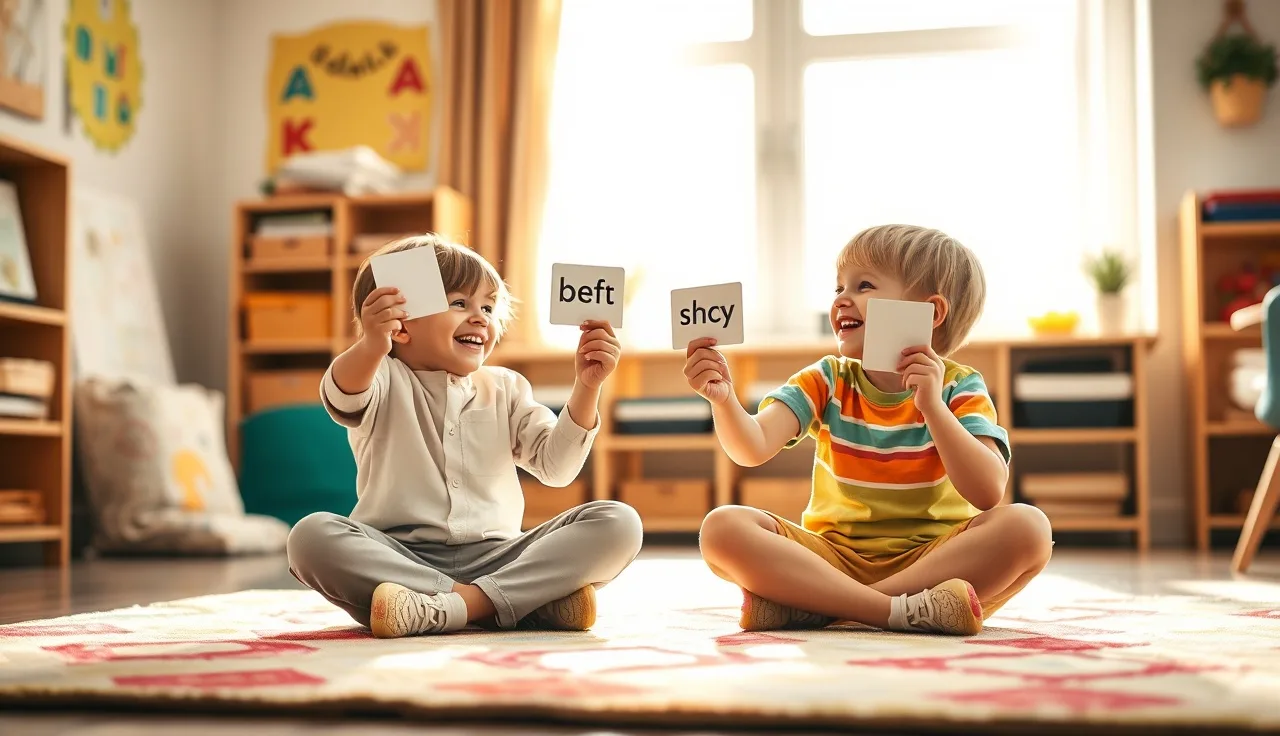
Games help because fluency requires repetition, and repetition is boring. A child will read the same ten word cards three times if it's a card game and zero times if you hand them a worksheet. That's not a knock on worksheets. It's just how motivation works for most kids, especially kids who already dread reading. The game structure keeps the reps coming without the dread.
The research is solid. A 2001 meta-analysis published in Psychological Science in the Public Interest found that guided repeated oral reading, the kind a game naturally produces, improved fluency and comprehension across grade levels [1]. Unassisted silent reading did not show the same effect. So the goal with any fluency game is simple: get the child reading words or text aloud, more than once, with feedback.
How is reading fluency actually measured, and what counts as on-track?
The most common fluency measure is oral reading fluency (ORF), expressed as correct words per minute (WCPM). A child reads a grade-level passage aloud for one minute. You subtract errors from total words read. That number gets compared to norms.
Hasbrouck and Tindal published the most widely used ORF norms, updated in 2017 [2]. Here's the 50th percentile (spring) for grades 1 through 6:
| Grade | 50th percentile WCPM (spring) |
|---|---|
| 1 | 53 |
| 2 | 89 |
| 3 | 107 |
| 4 | 123 |
| 5 | 139 |
| 6 | 150 |
These numbers come from the Hasbrouck and Tindal 2017 norming study, which used a sample of roughly 3.1 million students [2]. A child reading below the 25th percentile usually gets flagged for intervention. A child reading below the 10th percentile consistently needs more than classroom differentiation alone.
Want a quick at-home check? Pick a passage your child has never seen at their grade level, set a timer for one minute, have them read aloud, and count words minus errors. Compare to the table above. It won't replace a formal assessment, but it tells you whether the gap is small or large. For more structured evaluation options, a reading comprehension test or a formal ORF probe run by a specialist gives a clearer picture.
Which reading fluency games have the strongest evidence behind them?
The honest answer: most games have never been studied in randomized controlled trials. What has been studied is the instructional method underneath a game. If a game reliably produces repeated oral reading with corrective feedback, it draws on a method with strong evidence. If it's mostly passive, it probably doesn't move the needle much.
Repeated reading is the most researched fluency technique. A child reads the same short passage until they hit a target WCPM, usually across three to five readings. Any game format that produces this draws on solid ground [1]. Partner reading games, where two kids alternate reading paragraphs and give each other feedback, also have consistent research support [3].
Word recognition games target automaticity: the point at which a child recognizes a word in under half a second without decoding it piece by piece. High-frequency word games (often called sight words practice) belong here, but so do timed nonsense-word drills, which are especially useful for kids with dyslexia because they force phonemic decoding rather than memorization by shape.
Here are game types ranked roughly by strength of evidence:
1. Repeated reading races (same passage, beat your own time) 2. Partner reading with error correction 3. Timed word card games (Go Fish, Concentration, flashcard races) 4. Reader's Theater (repeated reading of a script to perform) 5. Phonics-based board games (Zingo, Phonics Bingo, Blending Boards) 6. Most reading apps (convenience is high, but feedback quality is inconsistent)
Reader's Theater deserves a special mention. A 2000 study by Rasinski and Padak found it produced significant fluency gains, and a later meta-analysis confirmed the effect across grade levels [4]. Kids are motivated to rehearse because there's a real audience. The repeated readings happen naturally. You can pull free Reader's Theater scripts from many public library websites and from ReadWorks.org.
What are the best free and low-cost fluency games for home use?
You don't need to spend money to build fluency at home. The most effective tools are often the cheapest.
Index cards and a stopwatch. Write 20 to 30 high-frequency words or words from whatever your child is currently reading. Time how fast they go through the deck. Do it again. The goal is to beat the previous time, not to beat anyone else. This costs nearly nothing and targets automaticity directly.
Sight word bingo. Print a free bingo grid from any teacher resource site (Teachers Pay Teachers has hundreds of free sets). You call a word, the child finds it. Works for 2 to 8 players. Scales to any word list your child's school is using.
Fluency partner reading with a stuffed animal. Silly but effective for young kids. The child reads a passage to a stuffed animal audience, then reads it again "because the bear didn't hear clearly." Three readings happen without a fight.
Reader's Theater scripts. Print a short script, assign parts, rehearse, perform. Free scripts are widely available through school and public library websites. This one is especially good for reluctant readers because it frames repetition as practice for a real event.
For kids around second grade, 2nd grade reading comprehension passages at a slightly easier level make excellent repeated reading material. Fluency games work best when the text sits at or just below the student's grade level.
The ReadFlare free reading toolkit includes printable word card sets and a fluency tracking chart parents can use at home, which is worth grabbing before you start.
Cardboard games worth buying: Zingo Sight Words ($15 to $20) and Blink ($8 to $12) both build word recognition speed and turn up at most toy stores or online. Neither is a cure. But both get played voluntarily, which means reps happen.
What games specifically help kids with dyslexia build fluency?
Kids with dyslexia have a core deficit in phonological processing, which makes word recognition slow and effortful even after they've learned phonics rules. Fluency games for dyslexic kids need to do one thing above all: reduce the cognitive load of decoding so that practice produces automaticity rather than exhaustion.
That means the game's words should be decodable at the child's current phonics level. There's no point in drilling words your child can't yet decode. If a child is working on CVC words (cat, sit, hop), the game should use CVC words. If they're on consonant blends, use blends. The International Dyslexia Association's structured literacy framework makes this point plainly: fluency instruction should follow the sequence of phonics instruction, not run ahead of it [5].
Nonsense word fluency games are especially valuable for dyslexic readers. Because the words don't exist, the child can't lean on visual memory. They have to decode. A card game where you flip nonsense word cards and race to decode them (with an adult providing corrective feedback immediately) hits the exact skill that's weakest. The DIBELS nonsense word fluency probe uses this approach [6].
Multisensory repetition games help too. Writing words in sand while saying each phoneme aloud, tapping sounds on fingers, or building words with letter tiles before reading them on cards all give more entry points for memory. These grow out of the Orton-Gillingham tradition, which has the longest track record among dyslexia-specific instructional approaches [5].
Reader's Theater works well for dyslexic kids for the same reason it works for everyone: the motivation to practice is built in. Pre-reading the script one-on-one with an adult before the group rehearsal gives the child a chance to decode difficult words ahead of time, which removes the shame of stumbling publicly.
If your child has a formal dyslexia diagnosis or is receiving special education services, fluency goals may already be in their IEP. If they're not, you can request they be added. Under the Individuals with Disabilities Education Act (IDEA), "each child's IEP must include a statement of measurable annual goals" [7], and oral reading fluency is a standard, measurable goal you can track with weekly ORF probes. A reading tutor who specializes in structured literacy can also run fluency game sessions and track progress more precisely than most classroom settings allow.
How do reading fluency games fit into a 504 plan or IEP?
Fluency games are more than a home tool. They can and should appear in school intervention plans.
If your child has an IEP, fluency can be a measurable annual goal. A well-written fluency goal looks like this: "By June, [child] will read a grade 3 passage at 90 WCPM with 95% accuracy, measured by weekly ORF probes." The game-based practice (repeated reading, Reader's Theater, partner reading) is the method used to reach that goal, not the goal itself. This distinction matters, because it means you can ask for specific fluency-building methods to be listed in the "specially designed instruction" section of the IEP.
For 504 plans, which cover students with disabilities who don't qualify for special education, fluency accommodations look different. A student might get extended time on reading tasks, access to audiobooks alongside print, or permission to pre-read passages before timed activities. These don't replace fluency instruction. They reduce the performance penalty while instruction catches up.
The Every Student Succeeds Act (ESSA) requires that interventions used in schools be evidence-based, defined as supported by "strong, moderate, or promising evidence" [8]. Repeated reading and Reader's Theater both clear that bar. If your school is using a fluency intervention and you want to know whether it's evidence-based, you can look it up in the What Works Clearinghouse database, which is maintained by the U.S. Department of Education [9].
Parents have the right to review all materials used in their child's program and to request an independent educational evaluation (IEE) if they disagree with the school's assessment. If fluency is a documented weakness and the school isn't addressing it, that's worth raising at the next IEP meeting with specific ORF data in hand.
What age do you start fluency games, and what do they look like at each stage?
You can start simple fluency work as early as kindergarten, but the right game looks very different at 5 versus 12.
Kindergarten and grade 1 (ages 5 to 7): Focus is almost entirely on phonemic awareness and early decoding, but fluency groundwork starts with high-frequency word recognition. Games like Sight Word Bingo, Snap (match two identical words), and simple word card races work well. Text should be simple decodable books or single sentences. For more ideas calibrated to this stage, see 1st grade reading comprehension for passage suggestions to pair with repeated reading.
Grade 2 and 3 (ages 7 to 9): This is the sweet spot for fluency intervention. Kids have enough phonics to decode, but reading is still slow for many. Repeated reading races, Reader's Theater, and partner reading all work well. Target WCPM should be climbing toward 90 to 107 by the end of grade 3 [2]. Board games that use short phrases rather than single words start to make sense here.
Grade 4 and 5 (ages 9 to 11): Fluency norms expect 120 to 140 WCPM by end of grade 5. Games at this level can involve longer passages, more complex scripts, and competitive elements. Timed rereading of content-area text (science passages, for example) helps fluency transfer beyond leveled reading books. 4th grade reading comprehension passages work well as repeated reading material here.
Middle school (ages 11 to 14): Fluency work often goes underground at this age because kids are self-conscious. Framing it as "reading practice" rather than a game helps. Audio-assisted reading, where the child reads along with a recording of the same passage at a slightly faster pace, is effective and doesn't feel babyish. Audiobooks paired with print text also build fluency through modeling. 6th grade reading comprehension provides passage-level content that fits this age.
Do reading apps actually improve fluency, or are they mostly hype?
Here's the honest version: the app market for reading is enormous, the marketing claims are bold, and the independent evidence is thin.
A 2015 review of educational apps in Psychological Science in the Public Interest found that most popular literacy apps rest on little peer-reviewed support, and the research that does exist is often funded by the app developer [10]. That doesn't mean all apps are useless. It means you should be skeptical of any app claiming to "fix" reading in a set number of minutes per day.
Apps with some evidence behind them: Lexia Core5 has been studied more than most, with peer-reviewed work showing fluency gains for students who use it as a supplement to classroom instruction. The RAVE-O program has peer-reviewed backing. Epic! and similar reading platforms have a wide library but don't directly teach fluency. They're more useful for building reading volume and stamina in kids who are already fluent enough to enjoy independent reading.
Apps to be cautious about: any app that mostly presents comprehension questions without repeated oral reading is not primarily a fluency tool. Gamified vocabulary apps are vocabulary tools. Audiobook apps are listening comprehension tools. All worthwhile. None of them fluency games.
For a struggling reader on a tight budget, a $5 deck of index cards and ten minutes of daily card races will probably beat a $10/month app subscription. The app is easier to hand off to a child unsupervised, which is a real parenting consideration. But the parent-involved game sessions produce better feedback loops.
How do you tell if a fluency game is actually working?
Track WCPM every two weeks. That's it. Read a fresh passage, one minute, count correct words, write it down. After four weeks of consistent game-based practice (four to five sessions per week, 10 to 15 minutes each), you should see a measurable increase. Research on fluency interventions suggests students receiving intervention gain roughly two WCPM per week, while students getting typical classroom instruction gain about one WCPM per week [3].
No gains after six weeks? Three things are usually the cause: the text is too hard, the sessions are too short, or the feedback is missing. Corrective feedback is the piece most home games skip. When a child misreads a word, the adult should say the correct word immediately, have the child repeat it, and continue. Not "sound it out." Not a lecture. Just the correct word, quickly, so fluency momentum doesn't break.
For kids with IEPs, schools should be running ORF probes at least monthly and sharing that data with parents. If your child's school isn't doing this, ask specifically for their progress monitoring data at the next meeting. IDEA requires that parents be informed of their child's progress toward annual goals as often as report cards are issued [7].
For a more structured approach to building comprehension alongside fluency, the how to improve reading comprehension guide pairs well with this one. Fluency and comprehension are linked: once a child reads more than 90 to 100 WCPM accurately, comprehension usually improves on its own, because working memory is freed up from the decoding effort.
What should you tell your child's teacher if you want fluency games included in class?
You don't need a legal fight to have this conversation, though knowing your rights doesn't hurt.
Start with data. Bring your at-home ORF numbers to the meeting. "I've been tracking his reading pace at home and he's at 62 words per minute on grade 3 passages. The Hasbrouck and Tindal norms put the 25th percentile for grade 3 spring around 79 WCPM. I'm concerned he's below benchmark." A teacher who hears that you know what WCPM means and where the norms come from will take the conversation more seriously.
Ask specific questions. "Is fluency being progress-monitored in class?" "Is he getting any small-group repeated reading practice?" "Could we add Reader's Theater or partner reading as a station activity?" Specific questions get specific answers. Vague concerns get vague reassurances.
If the teacher is receptive but pressed for time, offer to send materials. Reader's Theater scripts, word card sets, and fluency tracking charts are all things a parent can print and provide. Teachers who are open but overwhelmed will often run something they don't have to build themselves.
If your child already has an IEP, fluency goals belong in writing, more than in conversation. Before the meeting, review the current IEP to see whether fluency is addressed. If it isn't, come with a proposed goal in writing and ask that it be considered for the next IEP revision. You have the right to request an IEP meeting at any time, not only at the annual review. The parent advocacy kit from ReadFlare includes a sample letter for requesting an IEP meeting specifically about reading progress, along with a fluency goal worksheet.
For broader context on how to build the case at school, the reading comprehension practice resources offer more talking points around what evidence-based reading support looks like day to day.
Are there fluency games designed for group or classroom use?
Yes, and some of them work well in mixed-ability classrooms because you can differentiate them by word list or passage level without the kids necessarily noticing.
Choral reading is the simplest group fluency game. The teacher or a fluent student reads a passage aloud while everyone follows along and reads silently, then the class reads it together aloud. The repetition is built in. No scoring, no winner, no embarrassment. Research on choral reading shows consistent small-to-moderate fluency gains [4].
Partner reading rotations (also called "Read to Someone" in some curricula) pair students and have them read alternate paragraphs while the partner follows along and marks errors on a simple checklist. The social pressure of a peer listener keeps kids on task better than you'd expect.
Fluency Idol is a classroom game where small groups practice a passage for a week and then present it to the class for feedback. The performance framing raises motivation to rehearse. Feedback stays constructive when it's structured as "two stars and a wish."
Word sorts and building races work for phonics-based fluency at the lower grades. Students sort word cards by pattern (short vowels vs. long vowels, for example), then race to rebuild the sort from memory. These naturally generate the repetition that builds automaticity.
For reading comprehension worksheets that actually work, by grade, pairing a worksheet with a fluency game session on the same passage first boosts comprehension scores, because the child already knows the text. That's a practical classroom pairing any teacher can use.
Frequently asked questions
How many minutes a day should a child practice reading fluency games?
Most reading intervention research uses 10 to 20 minutes of daily fluency practice as the dose. Four to five sessions per week produces better results than one long weekly session. For struggling readers, consistency matters more than session length. Even 10 minutes of daily repeated reading with a parent or sibling produces measurable WCPM gains within four to six weeks if the text level is right and feedback is immediate.
What reading fluency games work for reluctant or anxious readers?
Reader's Theater works well because performance is the goal, so repetition feels purposeful rather than remedial. Reading to a stuffed animal, pet, or baby sibling removes the audience pressure entirely. Racing against their own previous time (not against another person) keeps motivation positive. The key is that error correction must feel supportive, not critical. One wrong word corrected calmly is fine. Five corrections in a row is demoralizing.
Can fluency games help with comprehension too, or just reading speed?
Both. Fluency and comprehension are closely linked in the reading research. The Simple View of Reading, a framework supported by decades of evidence, defines reading comprehension as the product of decoding and language comprehension. When fluency improves, cognitive resources shift from decoding to meaning-making. A 2001 National Reading Panel review found that guided repeated oral reading improved both fluency and comprehension scores at the same time [1].
Are sight word games the same as fluency games?
They overlap but they're not identical. Sight word games (like Dolch or Fry word drills) build automaticity for specific high-frequency words, which feeds fluency. Fluency games target the broader skill of reading connected text smoothly and with expression. Both are useful. For struggling readers, sight word automaticity is often the faster win. Fluency with full passages takes longer to develop. See the sight words guide for word list resources.
My child reads accurately but very slowly. Is that still a fluency problem?
Yes. Fluency has three components: accuracy, rate, and prosody (expression). A child who is accurate but very slow has a rate problem, which is usually an automaticity problem. Word recognition isn't automatic yet, so each word demands deliberate decoding. Timed repeated reading games that target WCPM directly are the right fix. Compare your child's rate to the Hasbrouck and Tindal 2017 norms to see how far below benchmark they are [2].
What fluency games help kids in grades 4 through 6 who are still struggling?
Older kids often need fluency work at an easier text level than their grade, which can feel embarrassing. Frame it as building speed and confidence, not catching up. Audio-assisted reading (reading along with a recording of a slightly challenging passage) works well for this age and feels less babyish. Content-area passages (science, social studies) at a controlled level help fluency transfer to academic reading. 4th grade reading comprehension and 6th grade reading comprehension passages are useful here.
Can a fluency game replace a reading tutor?
No, not if a child has significant deficits. Games are a delivery mechanism for practice. They don't provide the diagnostic skill, the phonics sequence, or the error analysis a trained tutor brings. Think of games as a way to extend the reps between tutor sessions, not replace them. A reading tutor who specializes in structured literacy can tell you exactly which game format to use and at what text level, which makes home practice far more efficient.
What's the difference between fluency games and phonics games?
Phonics games teach letter-sound relationships and decoding rules. Fluency games build speed and automaticity with text the child can already decode. A child needs phonics before fluency work makes sense. If a child still struggles to decode CVC words, a fluency race game is frustrating rather than helpful. Check that your child's phonics level matches the game's word list. If not, back up to phonics first.
How do I know if my child's school is using evidence-based fluency instruction?
Ask which program or approach the school uses for fluency intervention, then look it up on the What Works Clearinghouse, maintained by the U.S. Department of Education [9]. Programs are rated on evidence strength. You can also ask whether progress is monitored with oral reading fluency probes and how often. Under ESSA, schools receiving federal Title I funds are required to use evidence-based interventions [8]. If you can't get clear answers, that itself is information worth noting.
Are fluency games appropriate for English language learners?
Yes, with adjustments. ELL students benefit from the same repeated oral reading approaches, but the vocabulary load matters more. Choose passages or word sets where the child knows most of the word meanings, more than the phonics patterns. Choral reading and partner reading help ELL students especially, because they provide an oral model alongside the text. Pre-teaching key vocabulary before a fluency game session produces better outcomes than fluency practice alone.
Can I use fluency games with a child who has an IEP or 504 plan?
Absolutely. Fluency games are a method of delivering practice, compatible with most IEP goals. If your child's IEP includes a fluency goal, ask the special education teacher which game formats they use in pull-out sessions so you can match them at home for consistency. Under IDEA, parents have the right to see all materials and methods used in their child's program [7]. Coordination between home and school practice is one of the strongest predictors of intervention success.
What printable resources can I use alongside fluency games at home?
Free repeated reading passages are available through the Florida Center for Reading Research (fcrr.org) and ReadWorks.org. Hasbrouck and Tindal's ORF norms are available as a free PDF from Behavioral Research and Teaching at the University of Oregon. For structured word card sets and progress tracking sheets, the printable reading comprehension page has downloadable options calibrated by grade level.
How do fluency games help kids with comprehension in middle school?
By middle school, most comprehension breakdowns trace back to either vocabulary gaps or slow, effortful word recognition that exhausts working memory before meaning can form. Fluency games that build word automaticity cut that cognitive drag directly. Audio-assisted reading with content-area text is the most practical format at this age. Once rate and accuracy stabilize, explicit comprehension strategies have room to work. The how to improve reading comprehension guide covers those strategies in detail.
Sources
- National Reading Panel (2000), and Kuhn & Stahl, Psychological Science in the Public Interest (2001), guided repeated oral reading meta-analysis: Fluency is one of five essential components of reading instruction; guided repeated oral reading improved fluency and comprehension across grade levels, while unassisted silent reading did not show the same effect.
- Hasbrouck, J. & Tindal, G., Behavioral Research and Teaching, University of Oregon (2017), Oral Reading Fluency Norms: Oral reading fluency norms for grades 1 to 6 at the 50th percentile (spring); study used approximately 3.1 million students.
- Chard, D.J., Vaughn, S., & Tyler, B.J., Journal of Learning Disabilities (2002), meta-analysis of fluency interventions for students with learning disabilities: Students in intervention gain approximately two WCPM per week; partner reading with error correction shows consistent research support.
- Rasinski, T., in Handbook of Reading Research, Vol. III (2000); and related Reader's Theater meta-analysis: Reader's Theater produces significant fluency gains; choral reading shows consistent small-to-moderate fluency gains in the literature.
- International Dyslexia Association, Knowledge and Practice Standards for Teachers of Reading (2018): Fluency instruction should follow the sequence of phonics instruction; Orton-Gillingham tradition has the longest track record for dyslexia-specific instruction; multisensory repetition is recommended.
- Dynamic Indicators of Basic Early Literacy Skills (DIBELS), University of Oregon Center on Teaching and Learning: Nonsense Word Fluency probe targets phonemic decoding by removing the possibility of visual word memorization.
- Individuals with Disabilities Education Act (IDEA), 20 U.S.C. § 1414(d): IDEA requires each child's IEP to include measurable annual goals and requires parents to be informed of progress toward goals as often as report cards are issued. The statute states: 'each child's IEP must include a statement of measurable annual goals.'
- Every Student Succeeds Act (ESSA), 20 U.S.C. § 7801(21), U.S. Department of Education: ESSA requires interventions to be evidence-based, defined as supported by strong, moderate, or promising evidence from peer-reviewed research.
- What Works Clearinghouse, U.S. Department of Education Institute of Education Sciences: WWC rates educational programs and interventions on evidence strength; parents and educators can search programs by name.
- Hirsh-Pasek, K. et al., Psychological Science in the Public Interest (2015), Putting Education in 'Educational' Apps: Most popular literacy apps rest on little peer-reviewed support; developer-funded studies dominate the app research landscape.