Last updated 2026-07-09
TL;DR
Tracing letter shapes helps young children remember letter-sound links, but only when the child says the sound out loud while tracing. Handwriting and phonics feed each other through a brain process called orthographic mapping. Tracing alone, with no phonics, does almost nothing for reading. A child who still struggles after weeks of steady practice may need a dyslexia screening.
What is ABC tracing, and why do teachers use it?
ABC tracing is what it sounds like. A child traces a letter's shape, on paper, in sand, or with a finger, while an adult names the letter or says its sound. It shows up in nearly every pre-K and kindergarten room in the country. Teachers use it because it gives kids a physical way to practice letter formation before their hands are steady enough for freehand writing.
It stuck around because it works for what it's built to do, which is get the shape of a letter into long-term memory. Trace the letter B while saying "buh" and three things happen at once. The visual system reads the shape. The motor system rehearses how to make it. The auditory system hears the sound. That three-way rehearsal beats staring at a flashcard.
Tracing is not a substitute for phonics instruction. It's a support for it. The difference matters, because some programs pile on tracing worksheets and skimp on real sound-letter work. That imbalance makes kids who copy letters neatly and can't decode a single word.
How do handwriting and phonics connect in the brain?
Handwriting and phonics share storage in the brain. When a child forms the letter S while hearing "sss," the motor memory and the sound memory get encoded together, so later the sight of S can trigger the motor trace, which cues the sound. There's a named region for this reading work: the visual word form area, sometimes called the "brain's letterbox."
Researchers have known since the early 2000s that this region, in the left occipito-temporal cortex, fires when skilled readers see written words [1]. The open question for early education is how the circuit gets built in the first place.
A 2012 study by Karin James and Laura Engelhardt at Indiana University found that children who practiced writing letters by hand showed stronger neural responses in letter-recognition areas than children who typed or traced pre-formed letters on a tablet. Their conclusion, straight from the paper: "The act of printing letters by hand, rather than perceiving letters or typing them, leads to increased neural processing" [2]. Tracing pre-formed letters landed in the middle, better than typing, weaker than freehand.
Reading scientists call the whole encoding process orthographic mapping: the brain's way of locking a spelling pattern to a pronunciation [3]. It's why programs that pair explicit phonics with letter-writing tend to beat programs that teach phonics on a screen with no physical part. It's also why children with dyslexia, who have a weaker phonological system, often need more multi-sensory practice, not less, to build the same links [4].
Does tracing letters actually improve reading and phonics skills?
Tracing helps, but only when it's tied straight to the sound. That's the honest version. The research is solid enough to act on, though most of the studies are small.
A 2017 study in Developmental Science by Sophia Vinci-Booher and colleagues found that kindergarteners who practiced writing letters by hand (tracing works as a scaffold here) showed stronger letter-sound knowledge than kids who only practiced reading letters by sight [5]. The effect was real, well past chance.
What the research does not back is the idea that tracing worksheets, on their own, teach phonics. A child who traces the letter A twenty times while thinking about lunch learns almost nothing about reading. The engagement has to be there. That means saying the sound aloud on every stroke, not once at the top of the page.
Here's what strong ABC tracing practice looks like in evidence-based programs:
- The child says the letter name AND its most common sound before starting.
- The child says the sound again while tracing each stroke.
- The child names a word that starts with that sound.
- The whole sequence runs about 90 seconds per letter.
Before you buy phonics worksheets or a commercial tracing book, check for that sound-production step. Plenty of them skip it, and that's a real problem for a beginning reader.
For a child who already reads simple words, tracing single letters buys you little. The mapping circuit is already primed. Tracing might still smooth out handwriting, but it won't speed up phonics. Spend that time on word-level decoding instead.
What is the right sequence for teaching the alphabet with phonics?
Teach the alphabet out of order. Sounds wrong, but A, B, C, D is a singing order, not a teaching order. It groups letters that trip up beginners and delays the payoff of reading a real word.
Most structured literacy programs lead with high-frequency sounds and keep confusable pairs apart. A common evidence-based sequence opens with S, A, T, I, P, N, because those six letters build dozens of simple words (sit, pin, tap, nap, tip) and give kids early decoding wins. Letters like B and D, mirror images and a known trap for kids with dyslexia, get separated by several weeks [6].
| Teaching priority | Letters | Why this order |
|---|---|---|
| First cluster | S, A, T, I, P, N | Build many decodable words at once |
| Second cluster | C/K, E, H, R | Add common short-vowel words |
| Third cluster | M, D, G, O | Introduces D after B is firm |
| Later | Q, X, Z, soft C/G | Low frequency; don't spend early weeks here |
This is the logic behind programs like Jolly Phonics, which you can read about at Jolly Phonics, and behind alphabet phonics curricula built for struggling readers.
Dollar-store ABC tracing books almost always run A to Z. That's fine for extra practice on letters a child already owns. It's a poor primary sequence.
What multi-sensory tracing techniques work best?
The best techniques put vision, hearing, touch, and movement to work at the same moment. That's what multi-sensory means. The Orton-Gillingham approach, the most researched multi-sensory reading method, has used this idea since the 1930s, and the core technique has held up [4].
For tracing, these variations do the most:
Sky-writing: The child traces the letter in the air with a full arm motion, big enough to work the shoulder and elbow, more than the fingers. Large movements recruit more motor cortex. The child says the sound on every stroke.
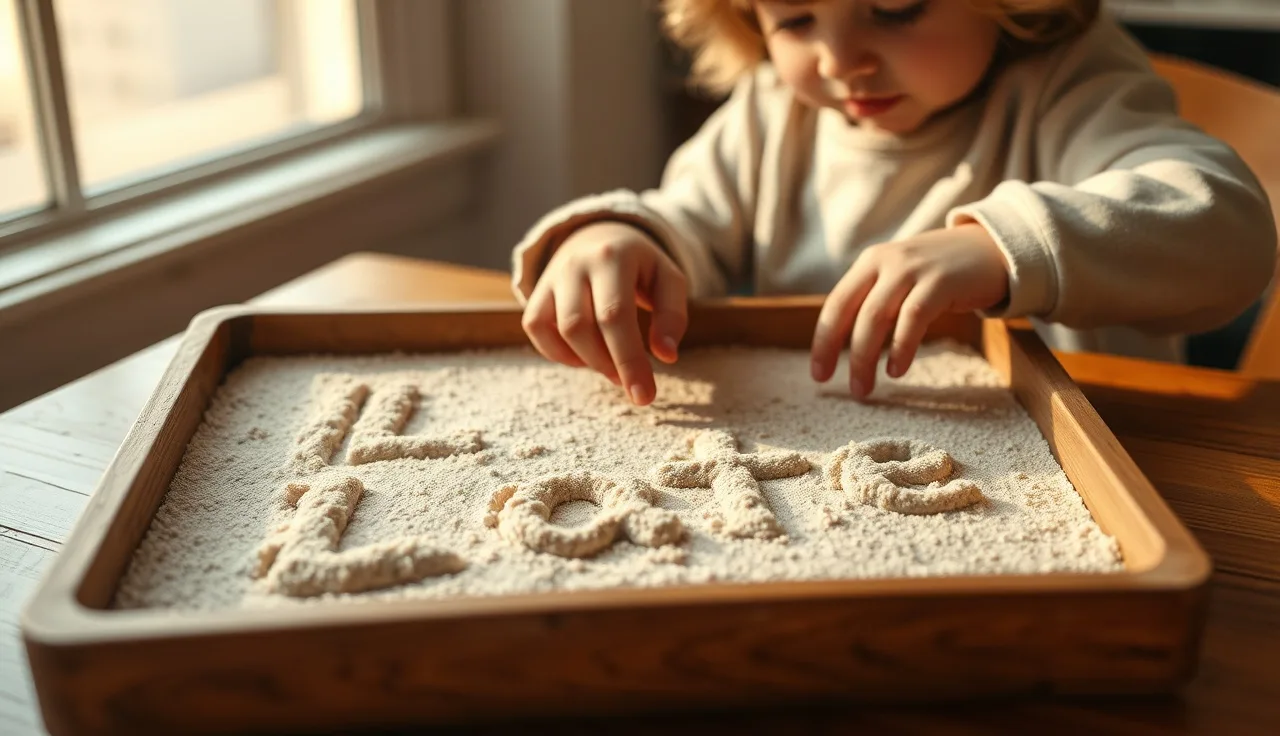
Sand or sensory tray tracing: The child traces in a shallow tray of sand, rice, or shaving cream. The feel of resistance and texture adds a channel that pencil-on-paper misses. It's a good fallback for kids who aren't responding to standard practice.
Finger tracing on textured letters: Sandpaper letters, from Montessori, give the shape a rough surface. Running a finger over it while saying the sound is one of the oldest and steadiest letter-learning methods around.
Simultaneous oral spelling (SOS): In Orton-Gillingham, the child says each letter name while writing it, then says the whole word, then reads it back. Tracing is a stepping stone to this, not a stand-in for it.
None of this needs pricey gear. A baking tray and some sand costs a couple of dollars. The real cost is time and consistency.
To pair tracing with something a reluctant kid will tolerate, phonics games with letter-formation components make the repetition go down easier.
At what age should kids be doing ABC tracing?
Push pencil tracing too early and you get frustration, not reading. Fine motor control comes in slowly. Most kids' grip and hand strength aren't ready for sustained pencil tracing until age 4 to 4.5 [7]. Before then, large-motor letter practice (finger in sand, sky-writing, forming letters from clay) fits better and often teaches more.
By age 5, most children in a typical range can trace letters with decent accuracy. That's also when kindergarten phonics usually starts in U.S. schools, so the pairing lines up.
A rough timeline:
- Age 3: Letter recognition begins; large-motor tracing in sand or air fits.
- Age 4 to 4.5: Pencil tracing on thick-lined paper works for many kids; stick to a few high-frequency letters.
- Age 5 to 6: Standard ABC tracing worksheets fit; pair every letter with its sound.
- Age 6 and up: Tracing should be handing off to freehand writing; heavy reliance past this point can signal a fine motor or phonological concern worth checking.
For kids with developmental delays, occupational therapists sometimes stretch tracing work into the elementary years. The phonics part continues no matter what the writing method looks like.
If your child is 7 or older and still leans on tracing supports, mention it to the school. It may matter for an evaluation under IDEA [8].
How do you know if tracing and phonics practice isn't enough?
When a child stalls after weeks of good, steady phonics practice, that stall is data. Most kids move forward with explicit instruction plus multi-sensory letter work. The ones who don't are telling you something.
The National Reading Panel's report, a federally commissioned review of the research, found that systematic, explicit phonics is far more effective than non-systematic or no phonics, and it works for most children [9]. The word "most" earns its keep in that sentence. For roughly 15 to 20 percent of children, standard phonics isn't enough, usually because of phonological processing differences consistent with dyslexia [4].
Signs your child may need more than standard ABC tracing and phonics:
- Still confusing B and D, or P and Q, after age 7
- Can't hold onto letter-sound links even after repeated practice
- Can't blend three-letter words (C-A-T) despite knowing each sound
- Avoids rhyming games or can't produce a rhyme
- Family history of reading difficulty (dyslexia runs in families)
Three or more of these means it's time to ask the school for a reading screening. A core phonics survey or quick phonics screener shows exactly where the breakdown sits.
Under the Individuals with Disabilities Education Act (IDEA), schools must evaluate a child for a disability when there's reason to suspect one [8]. Put the request in writing. "I suspect my child may have dyslexia and I am requesting a full evaluation" is enough to start the clock. The school has 60 days under federal law (some states set shorter timelines) to finish the evaluation.
The ReadFlare parent advocacy kit has a sample letter you can copy for that request.
What does the research say about digital tracing apps versus pencil and paper?
Nobody has good long-term data on reading-app outcomes for early phonics learners yet. This is a contested area, and I won't pretend otherwise. The closest evidence comes from the handwriting research.
The James and Engelhardt 2012 study found that typing and tracing on a pre-formed digital template produced weaker neural letter-recognition patterns than freehand handwriting [2]. Most tracing apps, including the popular tablet ones, are pre-formed templates: the child drags a finger along a dotted line and the app keeps them inside it. That's a different motor task from freehand tracing on paper, where the child has to generate the letter's path internally.
Some apps do add value. Sound prompts, instant feedback, and letter-sound pairing that paper can't give. If an app makes the child say the sound while tracing and corrects the formation, it's a reasonable supplement.
Treat apps as a sometimes-food, not a main course. A few minutes a day on a well-built tracing app with sound is fine. Forty-five minutes a day on a tablet while a parent assumes phonics is happening is a different thing entirely.
For structured digital and paper materials with a stated method, phonics for reading programs beat the general app store as a starting point.
How should parents do ABC tracing practice at home?
You don't need a reading credential to run good letter-sound practice at home. Here's a protocol that fits in 10 to 15 minutes a day.
Step 1: Pick two or three letters, not the whole alphabet. Two letters practiced to automatic beats twenty letters skimmed.
Step 2: Say the letter name, then the sound, then a keyword. "This is the letter M. M says 'mmm.' Mouse starts with M."
Step 3: Have the child trace while saying the sound. The sound, not the name. Every stroke, "mmm."
Step 4: Have the child write the letter from memory. Messy is fine. The freehand retrieval step is where the learning sets.
Step 5: Find the letter in a book or on a page. Spotting it in real print connects practice to reading.
Run this for two or three letters until they're solid, then add more. Don't move on until the child can make the shape and the sound with no prompt.
For free structured worksheets that follow this logic, the kindergarten phonics worksheets section has options built on evidence-based sequences. The ReadFlare free reading tools also include letter-sound tracking sheets for logging progress at home.
One more thing, and it's not a soft one. Keep the emotional temperature low. A child already anxious about reading will shut down if practice turns into a fight. Short sessions, specific praise ("You remembered M says 'mmm' without my help"), and stopping before the child is fried are what the research on motivation and skill acquisition supports [10].
What phonics programs use ABC tracing as part of a structured curriculum?
Several well-known structured literacy programs build letter tracing into early instruction. Here's where they split.
Orton-Gillingham: The original structured literacy approach. Letter tracing with simultaneous sound production is a core early technique. It's taught one-on-one or in small groups by a trained instructor. It's not a boxed curriculum you buy; it's a training approach instructors use to design lessons [4].
Jolly Phonics: A UK-born program widely used in the U.S. Each sound comes with an action, a song, and letter formation. Tracing is in from lesson one. It teaches 42 letter sounds in a sequence that builds decodable words fast. More at Jolly Phonics.
Alphabet Phonics: Built straight from the Orton-Gillingham tradition, this structured curriculum for struggling readers uses multi-sensory letter formation on purpose. See alphabet phonics.
Hooked on Phonics: A commercial program with letter tracing in its early levels. It's more consumer-facing and less clinically structured than OG-based programs. Worth knowing, not my first pick for a child with suspected dyslexia. Full breakdown at Hooked on Phonics: what it is, cost, and does it work.
Fundations (Wilson): A widely used classroom program with explicit letter formation and a consistent verbal path (letter name, keyword, sound while forming the letter). Many teachers pair it with tracing in kindergarten and first grade.
If your child's school uses a program you've never heard of, ask them to show you the research base. Under the Every Student Succeeds Act (ESSA), schools are directed to use evidence-based practices [11]. That's more than nice language. You can ask whether the program is rated by the What Works Clearinghouse [12].
For a wider view of how these fit together, abc phonics covers early alphabet-plus-phonics instruction.
How does ABC tracing fit into broader reading development milestones?
Tracing is an early-stage tool. For most kids it belongs in pre-K through early first grade. Knowing where it sits saves parents from two opposite mistakes: racing past it, or clinging to it.
The Science of Reading framework, now the basis for reading reform laws in roughly 40 states as of 2024, describes reading in overlapping phases [3]. In the earliest phase, children build phonemic awareness (hearing sounds in words), letter-sound knowledge, and print concepts. ABC tracing feeds letter-sound knowledge directly. But phonemic awareness comes first, before there's anything to trace: clapping syllables, rhyming, and hearing the first sound in a word are pre-tracing skills.
Once letter-sound knowledge is solid, instruction moves to blending (pushing sounds together to read words), segmenting (pulling words apart to spell them), and then patterns (digraphs, blends, vowel teams). Tracing single letters has no role in those stages. A second grader spending twenty minutes a day on tracing worksheets is spending it wrong. Word-level decoding would do more.
A quick check: if your child reads simple three-letter words (CVC words like cat, pin, hop) consistently, tracing the individual letters of the alphabet is no longer the priority. Move the practice to tracing or writing whole words, which is a different skill with different brain demands.
For how phonics for kids should progress across grades, that resource maps the full skill sequence in plain terms.
Frequently asked questions
Does tracing letters help kids learn to read?
Yes, but only when paired with saying the sound out loud. Tracing while voicing the phoneme fires a motor-auditory-visual loop that stores letter-sound links more durably than flashcards alone. James and Engelhardt (2012) found handwriting, including tracing, produced stronger neural letter-recognition patterns than typing or purely visual study. Tracing in silence, with no sound, does very little.
What age should kids start tracing letters?
Most children's fine motor control is ready for pencil tracing around age 4 to 4.5. Before that, large-motor tracing in sand, air, or clay fits better. By age 5, standard tracing worksheets suit most kids. If a child older than 6 still leans heavily on tracing, raise it with the school and ask whether a reading or occupational therapy evaluation makes sense.
Should kids trace letters or write them freehand?
Both help, but freehand writing produces stronger brain activation for letter recognition than tracing a pre-formed template, per neuroimaging research. Use tracing as a scaffold when a child first meets a letter's shape. Once the shape is familiar, freehand practice, even messy, sets the learning more firmly. Good sequence: trace first, copy from a model, then write from memory.
What is orthographic mapping, and how does tracing help?
Orthographic mapping is how the brain permanently links a word's spelling, pronunciation, and meaning into one memory unit. For young children still learning the alphabet, tracing a letter while saying its sound is an early version of this at the letter level. The motor memory of forming the letter links to the phoneme, making later retrieval faster and more automatic.
What order should I teach the alphabet letters in?
Not A to Z. Evidence-based programs teach high-frequency letters first in sequences that let children build decodable words fast. A common opening cluster is S, A, T, I, P, N, because those six letters combine into many simple words. Similar-looking letters like B and D get separated by several weeks to prevent confusion. Alphabetical order works for learning letter names, not for phonics.
My child knows all the letter names but can't remember the sounds. What's wrong?
Letter names and letter sounds are different skills that develop somewhat separately. Many children learn names from alphabet songs long before they connect those names to sounds. The fix is more phoneme-focused practice: saying the sound (not the name) while tracing, sound-sorting activities, rhyming games. If the gap holds past mid-first grade, ask the school for a phonological awareness screening.
Are tracing apps as good as paper tracing for phonics?
Probably not equal. Handwriting research suggests that following a pre-formed digital template, which most tracing apps use, produces weaker neural letter-recognition patterns than freehand writing on paper. Apps with sound prompts and letter-sound pairing beat shape-only apps. Use apps as a short supplement, not the main practice, especially for a child already struggling with phonics.
My child reverses letters like b, d, p, q. Does more tracing help?
Letter reversals are normal through about age 7. After that, persistent B and D confusion is one of the classic markers linked to dyslexia. Generic tracing may not help if the root issue is phonological processing. Multi-sensory cues that tie the sound to a memorable physical anchor ("b is the bat before the ball") tend to beat repetitive tracing. If reversals persist at age 8, request a school evaluation.
How many letters should I practice with my child per day?
Two or three, practiced to automatic, beats covering the whole alphabet shallowly. Depth wins in early letter-sound work. Practice each letter until the child produces shape and sound with no prompt, then add new ones. Move on too soon and the letter won't be there when the child needs it to decode a real word.
What is the best multi-sensory method for teaching letter sounds at home?
Sky-writing (tracing large letters in the air with the full arm), sand-tray tracing, and textured sandpaper letters are all evidence-based options you can run at home with no training. The key in each is simultaneous sound production: the child says the phoneme, not the letter name, on every stroke. Five to ten minutes of focused practice beats longer sessions without the sound.
When should I ask the school to evaluate my child for dyslexia?
Under IDEA, schools must evaluate when there's reason to suspect a disability. You don't need a diagnosis first. Put the request in writing: state that you suspect dyslexia and are requesting a full evaluation. The school has 60 days under federal law (some states require less) to finish it. Warning signs: persistent letter-sound confusion past age 7, inability to blend three-letter words, and a family history of reading difficulty.
Can phonics tracing practice hurt a child who is not ready?
It's unlikely to cause harm, but it can breed frustration and avoidance if pushed too hard, too early. A child whose fine motor control isn't ready for pencil work will find tracing aversive, and a bad emotional link to letter practice works against you. Large-motor alternatives like air writing or sand tracing are gentler entry points and hit the same phonological goal.
Do tracing workbooks from stores use a good phonics sequence?
Most don't. Consumer ABC tracing books almost always run alphabetical order, handy for marketing, weak for phonics learning. They also rarely include sound-production prompts. They're fine for supplementing letters a child already knows, or for handwriting apart from phonics. For primary phonics instruction, structured literacy materials with a research-backed letter sequence are the better buy.
What if my child hates tracing?
Many kids do, especially those with dyslexia or fine motor trouble, for whom the task is simply harder. Alternatives that hit the same letter-sound goal include sky-writing, sand-tray play, forming letters from clay, and building them from craft sticks. Keep sessions to five minutes, offer specific encouragement, and put the sound production ahead of a perfect letter. The sound is the point. The tracing is just the delivery.
Sources
- Dehaene et al., Science, 2010, 'How Learning to Read Changes the Cortical Networks for Vision and Language': The visual word form area in the left occipito-temporal cortex responds specifically to written words in skilled readers.
- James & Engelhardt, Trends in Neuroscience and Education, 2012, 'The effects of handwriting experience on functional brain development': Children who practiced letters by hand showed stronger neural responses in letter-recognition areas than those who typed or traced pre-formed templates; quoted conclusion: 'The act of printing letters by hand, rather than perceiving letters or typing them, leads to increased neural processing.'
- Kilpatrick, D.A., 'Equipped for Reading Success' (2016); also foundational to Science of Reading framework: Orthographic mapping is the process by which the brain stores spellings, pronunciations, and meanings of words as permanent memory units.
- International Dyslexia Association, 'Orton-Gillingham: What Is It?': Orton-Gillingham and multi-sensory structured literacy approaches are the most researched interventions for dyslexia; roughly 15 to 20% of children have phonological processing differences consistent with dyslexia.
- Vinci-Booher et al., Developmental Science, 2017, letter writing and letter-sound knowledge study: Kindergarteners who practiced writing letters by hand showed stronger letter-sound knowledge than those who practiced reading letters only visually.
- Ehri, L.C., Scientific Studies of Reading, 2014, 'Orthographic Mapping in the Acquisition of Sight Word Reading, Spelling Memory, and Vocabulary Learning': Letter-sound sequence design that separates visually similar letters (B/D, P/Q) reduces early confusion in beginning readers.
- CDC, Developmental Milestones: 4 Years: Fine motor control sufficient for pencil use develops for most children around age 4 to 4.5.
- U.S. Department of Education, Individuals with Disabilities Education Act (IDEA), 20 U.S.C. § 1414: Under IDEA, schools must evaluate a child for a disability when there is reason to suspect one; the federal timeline for completing evaluation is 60 days from parental consent.
- National Reading Panel, 'Teaching Children to Read' (2000), NICHD: Systematic, explicit phonics instruction is significantly more effective than non-systematic or no phonics instruction, per the federally commissioned National Reading Panel report.
- Deci & Ryan, Self-Determination Theory; applied to literacy in Guthrie et al., Elementary School Journal, 2007: Short, success-oriented practice sessions with specific praise support motivation and skill acquisition in early learners.
- U.S. Department of Education, Every Student Succeeds Act (ESSA), Evidence Requirements: Under ESSA, schools are directed to use evidence-based practices; the What Works Clearinghouse rates educational programs by their research base.
- What Works Clearinghouse, Early Literacy Interventions: The What Works Clearinghouse provides evidence ratings for literacy programs used in U.S. schools, including early phonics programs.