Last updated 2026-07-10
TL;DR
Phonics cards pair a letter or letter pattern with its sound. Used for 5 to 10 minutes daily with immediate corrective feedback, they're one of the most research-backed ways to build decoding speed. The best cards follow the phonics sequence your child's school or tutor already uses. Free printable sets work as well as expensive ones for most kids.
What are phonics cards and how do they actually work?
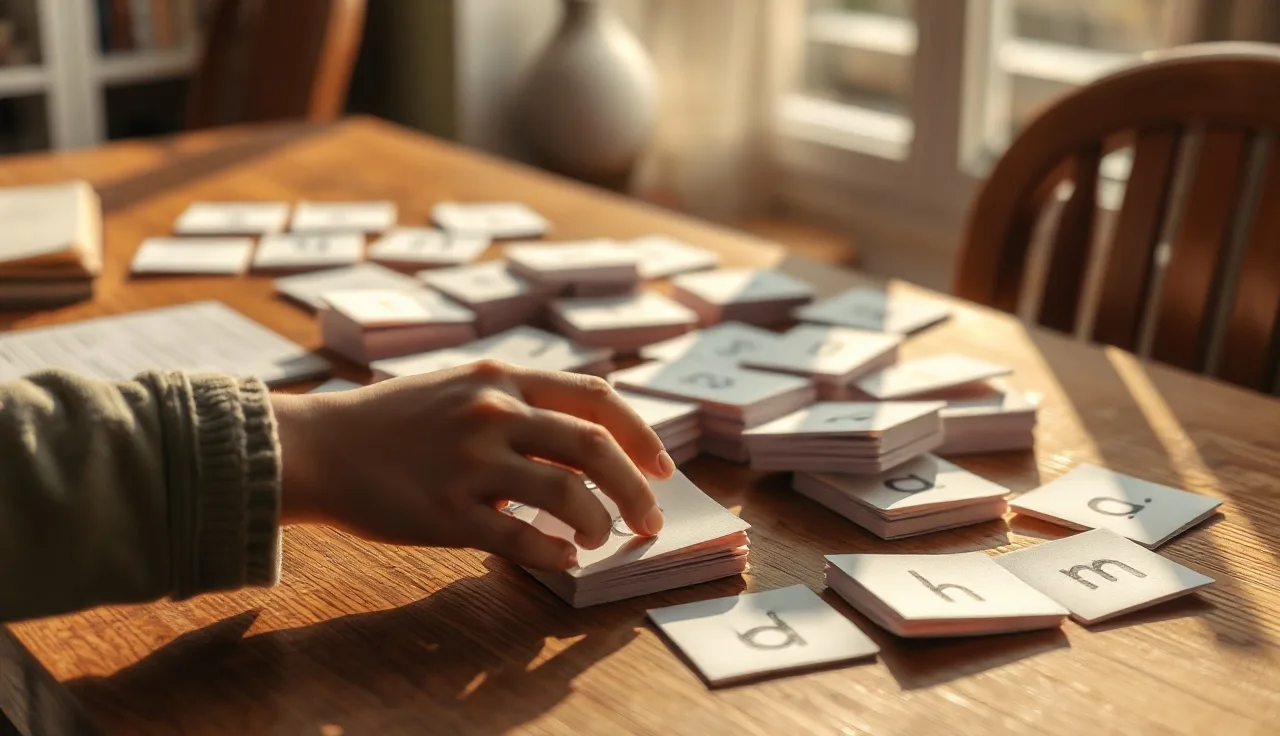
Phonics cards are single-concept flash cards. One side shows a letter, letter combination, or word pattern. The other side shows the sound it makes, sometimes with a keyword picture to anchor memory. That's the whole design. Simple on purpose.
The reason they work comes straight from cognitive science. Reading asks a child to map printed symbols onto sounds fast enough that working memory doesn't buckle before the word is decoded [1]. A child who stops to laboriously sound out every letter in "sh" often loses the meaning of the sentence by the time they hit the period. Cards build what researchers call orthographic mapping, the process of storing a word's spelling, pronunciation, and meaning together as one mental unit [2]. Daily retrieval practice speeds that mapping up.
Retrieval is the key word. Passively staring at a card does almost nothing. The child has to say the sound out loud before flipping the card, get corrective feedback the instant they're wrong, and move the card to a "mastered" pile only after several correct responses in a row. Active retrieval with feedback is what the research keeps supporting [1].
For a deeper look at the underlying theory, see our phonics definition explainer, which covers the full alphabetic principle.
What does the research say about using flash cards for phonics?
The honest answer: cards themselves haven't been studied in big randomized trials the way whole reading programs have. What has been studied hard is the mechanism behind them. Systematic, explicit phonics instruction with immediate corrective feedback and spaced practice.
The National Reading Panel's 2000 report analyzed 38 studies of systematic phonics instruction and found it produced significantly better outcomes in decoding, word reading, and comprehension than non-systematic or no-phonics instruction [3]. Cards are one vehicle for that systematic practice. A 2012 meta-analysis in the Journal of Learning Disabilities, looking at interventions for students with reading disabilities, found that phonics-based word study with flashcard-style practice produced effect sizes around 0.59 to 0.86 for word reading accuracy [4]. That's a meaningful gain.
Spaced repetition (reviewing items at widening intervals) is especially well-supported. A 2008 review in Psychological Science in the Public Interest concluded that distributed practice beats massed practice for retention across nearly every category of learner [5]. Many modern card systems, including Barton's red/yellow/green sorting method and Orton-Gillingham decks, are built on exactly this principle even when they don't name it.
So cards are not magic. Used with the right technique, they turn what the science says works into something you can do at your kitchen table.
What types of phonics cards are there, and which should you use?
There are four main types. Choose the wrong one for your child's level and you waste time.
Letter-sound cards (alphabetic level) cover individual consonants and short vowels. These are for beginning readers, roughly pre-K through mid-kindergarten, or any child who hasn't yet locked in the basic 26 letter sounds. If your child already knows these, skip them.
Phonogram cards (pattern level) cover vowel teams, digraphs, blends, and other multi-letter patterns: "oa," "sh," "thr," "igh," "tion." This is where most struggling readers in grades 1 through 3 actually need work. A child who reads "boat" as "bot" doesn't have a letter problem. They have a vowel team problem.
Word family or rime cards bundle patterns into families like "-ack" or "-ight." Useful, but slightly less transferable than phonogram cards, because a child can memorize the family without grasping the pattern underneath it.
Word cards show whole decodable words for fluency practice at a given level. Use these after a pattern has been introduced and partly mastered on phonogram cards, not before.
The abc phonics and alphabet phonics articles on this site cover the alphabetic level in detail. For pattern-level work, the phonics for reading article explains how programs sequence those patterns.
| Card Type | Target Skill | Best Age/Stage | Example Patterns |
|---|---|---|---|
| Letter-sound | Basic alphabetic principle | Pre-K to K | b=/b/, short a |
| Phonogram | Vowel teams, digraphs, blends | K to grade 3 | oa, sh, thr, igh |
| Word family/rime | Pattern recognition in context | Grade 1 to 2 | -ack, -ight, -ame |
| Decodable word | Fluency at known level | Any, after intro | ship, coat, bright |
How do you use phonics cards correctly for the best results?
Most parents hold up a card and accept a vague mumble. Vague input, vague results.
Here's the sequence that produces the gains the research supports. Hold the card up with the letter or pattern showing. Give one to two seconds of wait time and don't prompt. The child says the sound out loud. If correct, affirm and move on. If wrong or hesitant, you say the correct sound, they repeat it three times, and the card goes back in the deck to show up again soon. That corrective feedback loop is the mechanism, not an add-on.
Keep sessions to five to ten minutes. Cognitive load is real, and a bored or frustrated child consolidates nothing. Short daily sessions beat long sessions twice a week, which is exactly what the spaced practice literature predicts [5].
Sort cards into three piles: unknown, practicing, and mastered. A card moves to "mastered" only after five to seven correct responses across different sessions, not five in a row in one sitting. The multi-session bar matters because it confirms the memory is durable, more than fresh.
For kids with dyslexia or real phonological processing weaknesses, pair the card with a physical gesture or arm-tapping to pull in more than one sensory channel. This is a core feature of Orton-Gillingham and multisensory structured literacy, and it has its own evidence base for students who don't respond to visual-only practice [6].
If you want a readymade way to track which patterns your child knows versus needs, the core phonics survey article walks through a free diagnostic that maps directly to a card practice sequence.
What's the right phonics sequence for the cards, and does order matter?
Yes. Order matters a lot.
Systematic phonics means patterns get taught from simpler to more complex in a deliberate order. Cards used out of sequence produce a child who can name "igh" but can't reliably decode short vowels. A house built on sand.
A standard research-supported sequence runs roughly like this. First, consonant sounds and short vowels. Then CVC words (consonant-vowel-consonant, like "cat" or "hit"). Then consonant blends and digraphs (bl, cr, sh, th, ch). Then long vowel silent-e patterns. Then vowel teams. Then r-controlled vowels (ar, er, ir, or, ur). Then multisyllabic word patterns.
The UFLI Foundations scope and sequence from the University of Florida, which is publicly available, lays this out plainly and works well as a blueprint for building a card deck [7]. If your child's school uses a specific structured literacy program like SPIRE, Barton, Wilson, or RAVE-O, use that program's sequence so home practice reinforces the classroom instead of fighting it.
If you don't know where your child currently sits in this sequence, the quick phonics screener is a fast at-home diagnostic that finds the right entry point.
Should you buy phonics cards or make your own?
Honest opinion: make your own or print free ones. Expensive commercial sets are not meaningfully better for most kids.
The research advantage lives in the teaching technique and the sequence, not the card stock. A laminated index card with "oa" written in marker does the same instructional job as a $40 phonogram deck.
Commercial decks do have real upsides. They come pre-sorted in a logical order, they often include keyword pictures that help anchor memory, and they save time you may not have. The widely used commercial sets include Barton phonogram cards (part of the Barton Reading and Spelling System), Orton-Gillingham phonogram decks from several publishers, and the free Spalding phonogram cards on the Spalding Education Foundation website.
For printable options that cost nothing, Teachers Pay Teachers hosts hundreds of free phonics card sets. The Florida Center for Reading Research (FCRR) at fcrr.org offers free downloadable student center activities built around phonics patterns that work like card practice [8].
The phonics worksheets article has a curated list of free printable resources if you want to build a fuller at-home practice packet beyond cards alone.
How do phonics cards fit into a broader reading intervention plan?
Cards are one tool, not a whole program. Knowing the difference keeps you from misusing them.
A complete phonics intervention has four moves: explicit introduction of a new pattern (the "I do"), guided practice with that pattern in decodable words (the "we do"), independent practice in decodable texts (the "you do"), and card practice as a fluency-building review of patterns already introduced. Cards live in the review phase. Using cards as the first introduction to a new sound is a common parent mistake, because it skips the explicit teaching step entirely.
If your child has an IEP or 504 plan, the reading goals should name which phonics patterns they're working on. Ask the school for the scope and sequence their reading specialist uses, then match your home card practice to it. Under IDEA, parents can review all educational records, including curriculum guides and progress monitoring data [9]. That data tells you where the cards should start.
For kids who need a full structured program rather than card supplements, the phonics for kids article compares programs by age and severity of need.
ReadFlare's free reading tools include a printable phonics card template sorted by the standard scope and sequence, available alongside the parent advocacy kit for families working through school reading supports.
Do phonics cards work for kids with dyslexia?
Yes, with modifications.
Kids with dyslexia often have weak phonological memory, so they don't retain sound-symbol associations as fast as typical readers [10]. The standard card routine still works. You just have to expect a longer path to mastery (more exposures before a card graduates to "mastered"), add multisensory components (say it, tap it, write it), and keep the "practicing" pile small so they aren't swamped.
The International Dyslexia Association's Knowledge and Practice Standards name phoneme-grapheme correspondence as a core instructional target for students with dyslexia, which is exactly what phonogram cards practice [6]. The same standards say instruction should be systematic, explicit, and include immediate corrective feedback. All of that maps straight onto the card technique above.
One specific modification: for a child who reverses b and d, use a tactile card where the letter is raised (foam sticker, puffy paint, or sandpaper) so they can trace it. The kinesthetic input gives an extra retrieval cue that visual-only cards can't.
The jolly phonics article covers a multisensory synthetic phonics program that many dyslexia specialists use alongside card practice.
How long does it take to see results from phonics card practice?
Parents want a number, so here's the honest range. Most kids show measurable improvement in specific pattern accuracy within three to six weeks of daily five-to-ten-minute practice, when the cards target patterns just above their current mastery level [1]. Fluency gains (speed, more than accuracy) usually take two to three months longer.
Nobody has clean data on home card practice by itself, because most studies fold card practice into larger interventions. The closest evidence comes from structured literacy tutoring that uses phonics card routines as one component. A 2019 study of a Tier 2 intervention in Reading and Writing found students receiving structured literacy with explicit phonics practice gained an average of 1.2 grade levels in word reading over 20 weeks, against 0.3 grade levels in the control group [11].
If you're doing everything right (right sequence, daily practice, corrective feedback) and see nothing in six to eight weeks, that's information. It may mean the sequence is wrong for where your child is, the sessions are too long and breeding fatigue, the child has a phonological processing deficit that needs more than home practice, or there's an undiagnosed hearing issue hurting sound discrimination. A formal reading assessment can rule those in or out. The phonics and stuff resource roundup links to free online screeners you can try before requesting a formal school evaluation.
What are the best free and paid phonics card sets in 2025?
Here's an honest comparison by category. Prices are approximate as of mid-2025.
Free options worth using: The FCRR Student Center Activities (fcrr.org) are research-developed, sorted by skill level, and free to download and print [8]. Starfall's free online phonics activities include printable card formats for early readers. Flyleaf Publishing offers a small set of free phonics card printables aligned to their decodable book levels.
Low-cost printed sets ($5 to $20): Teachers Pay Teachers has many well-reviewed sets in the $3 to $8 range. Pick ones that state the scope and sequence they follow. Edupress phonics flash cards sell at school supply stores and Amazon for around $8 to $12 per level.
Mid-range sets ($20 to $60): Lakeshore Learning's phonics card sets are durable and well-sequenced at around $25 to $40. Really Great Reading's phonogram card set runs about $35 and follows a standard OG sequence.
High-end program-integrated decks ($60 and up): Barton's phonogram cards come inside the Barton system (level sets run $299 and up). Wilson's phoneme card kit for practitioners runs $50 to $80 on its own. These are built for intensive intervention and are overkill for a child with mild decoding struggles.
For kindergarten-level practice, the kindergarten phonics worksheets article pairs well with early card sets.
| Set | Cost | Best For | Sequence Provided |
|---|---|---|---|
| FCRR Student Center Activities | Free | K-grade 3, all levels | Yes (by skill) |
| TPT phonics cards (varies) | $0-$8 | Flexible | Varies by product |
| Edupress flash cards | $8-$12/level | Early readers | Partial |
| Lakeshore Learning | $25-$40 | K-grade 2 | Yes |
| Really Great Reading phonogram deck | ~$35 | Grade 1-3, OG approach | Yes |
| Barton phonogram cards | Included in system | Dyslexia intervention | Yes (OG-based) |
Can phonics card games make practice more engaging for reluctant readers?
Yes, and for kids who fight formal card drills, games are often the only way to bank the daily repetitions.
The goal doesn't change. The child retrieves the sound, gets feedback, and the pattern gets enough exposures to stick. Games just add a motivation layer.
Formats that work well in practice: Go Fish with phonogram cards (match two cards with the same vowel team), Slap It (spread cards face up, you say a sound, the kid races to slap the right one), Speed Sort (time how fast they can sort a deck into vowel teams vs. consonant digraphs vs. blends), and Memory using cards where one shows the pattern and its match shows a keyword picture.
One note that matters. Keep the competition low-stakes if your child has already felt reading failure. A kid who feels bad about reading will shut down the moment a card game becomes proof of how much they don't know. Play cooperatively against a timer, not against a sibling.
The phonics games article goes deep on formats by phonics level, with several that need nothing beyond cards you already own.
How do you know which phonics patterns to target first?
Start with a quick informal assessment, not a guess.
Write 20 to 30 words on paper that sample different patterns across the standard scope and sequence. Have your child read them aloud. Mark which patterns produce errors. The patterns one level below the first spot where errors show up consistently are your starting point. You want to begin just under the frustration level, building fluency on nearly-mastered patterns while introducing the next challenge.
Formal tools that do this systematically include the Core Phonics Survey from Curriculum Associates (free to download) and the Quick Phonics Screener from Jan Hasbrouck (available through her publisher, Read Naturally). Both give you a pattern-by-pattern map of what's known and what isn't.
If your child is in school and getting reading support, ask the reading specialist what assessment data they already have. Under IDEA's procedural safeguards, schools must share evaluation data with parents on request [9]. That data may already pinpoint which phonics patterns need work, which saves you the diagnostic step.
Frequently asked questions
At what age should kids start using phonics cards?
Most kids are ready for basic letter-sound cards around age 4 to 5, once they can hear individual sounds (can they tell you 'cat' starts with /k/?). Starting earlier tends to produce memorization without meaning. There's no upper age limit. Struggling readers in middle school regularly use phonogram cards as part of structured literacy intervention.
How many phonics cards should be in a practice deck at one time?
Keep the active practicing pile to eight to twelve cards. More than that swamps working memory and slows consolidation. As cards move to mastered, pull in new ones. This is the same logic behind spaced repetition software like Anki, and the distributed practice research backs it up.
My child memorizes the card but can't read the pattern in a real book. Why?
That's the transfer problem. Card mastery doesn't jump to text on its own unless you bridge it. Once a card is mastered, give the child three to five sentences with words containing that pattern and have them decode those words in context. The card built the isolated skill. Reading in context builds application. Decodable books at the right level are the best bridge.
Are digital phonics flash card apps as good as physical cards?
Close to equivalent if the app makes the child retrieve (say the sound before the answer shows) and gives immediate corrective feedback. Apps that auto-advance or just play animations without asking the child to produce the sound are passive and weaker. Free options like Quizlet (with custom sets) or the IXL phonics module meet the active-retrieval bar reasonably well.
Can phonics cards help with spelling as well as reading?
Yes. Run the drill backward: say the sound, the child writes the letter or phonogram. That's the encoding direction, and it reinforces the same orthographic mapping from both ends. Orton-Gillingham uses this two-direction routine, first reading the card (decoding) then writing the pattern from dictation (encoding), as a core practice.
What's the difference between phonics cards and sight word cards?
Phonics cards target patterns that decode by regular rules. Sight word cards traditionally target irregular or high-frequency words. The line is blurrier than it sounds: many so-called sight words are actually decodable once you know the pattern ('said' follows a pattern, just an uncommon one). Phonics cards transfer better because they teach a rule rather than a single word.
My child's school says phonics cards are 'drill and kill.' Should I be worried?
That pushback usually reflects an old whole-language bias against isolated skill practice, not current evidence. The What Works Clearinghouse and the National Reading Panel both find systematic phonics, including isolated phoneme-grapheme practice, significantly more effective than meaning-based approaches alone. If a school calls all phonics card practice harmful, that's a red flag worth raising with the principal or district reading coordinator.
How do I know if my child needs more than just home phonics card practice?
If daily card practice for six to eight weeks produces no measurable improvement, or your child shows signs beyond phonics (trouble with rhyming, oral language delays, a family history of dyslexia), request a formal evaluation through the school. Under IDEA, schools must evaluate at no cost to parents when there's reason to suspect a disability, including a learning disability affecting reading.
Do phonics cards work for English language learners?
Yes, with one adjustment. ELL students may lack the oral English vocabulary to use keyword pictures reliably. For those kids, pair the phonogram with a picture of a concrete, familiar object rather than an abstract word. The phonics-to-sound mapping is language-neutral. The vocabulary anchor is where translation support helps most.
What's the Orton-Gillingham approach to phonics cards specifically?
Orton-Gillingham drills phonogram cards (usually a deck of 70+ letter combinations) daily in two directions: visual-auditory (see the card, say the sound) and auditory-visual (hear the sound, write the phonogram). Cards are reviewed every lesson and retired to a separate deck only after mastery across multiple sessions. The International Dyslexia Association recognizes OG as a structured literacy approach with an evidence base for students with dyslexia.
Are there phonics cards specifically designed for older students and adults?
Yes. Really Great Reading, the Wilson Reading System, and Barton all make card materials built for adolescent and adult learners, with less juvenile artwork and more mature keyword words. The phonics content is identical to children's cards. Only the visual presentation changes. Older struggling readers benefit from the same systematic phonogram practice, and embarrassment about the task is the main barrier to manage.
How do phonics cards fit into an IEP reading goal?
A decoding goal might read something like 'Student will accurately decode single-syllable words containing vowel teams with 80% accuracy.' Phonogram card practice supports that goal directly. Ask the IEP team which phonogram cards the school specialist uses so your home practice matches. Schools aren't required to prescribe home practice, but they should share their instructional sequence with you.
Sources
- Kilpatrick, D.A. (2015). Essentials of Assessing, Preventing, and Overcoming Reading Difficulties. Wiley. (orthographic mapping theory): Orthographic mapping is the process by which readers store spelling, pronunciation, and meaning together as a unified mental unit, enabling sight word acquisition and reading fluency
- Wanzek, J. et al. (2012). A Synthesis of Extensive Early Reading Interventions. Journal of Learning Disabilities.: Phonics-based word study with flashcard-style practice produced effect sizes of approximately 0.59 to 0.86 for word reading accuracy in students with reading disabilities
- Cepeda, N.J. et al. (2008). Spacing Effects in Learning. Psychological Science in the Public Interest.: Distributed (spaced) practice consistently outperforms massed practice for long-term retention across virtually all learner categories
- International Dyslexia Association, Knowledge and Practice Standards for Teachers of Reading (2018): Phoneme-grapheme correspondence is a core instructional target for students with dyslexia; instruction should be systematic, explicit, and include immediate corrective feedback
- University of Florida Literacy Institute, UFLI Foundations Scope and Sequence: UFLI Foundations provides a publicly available systematic phonics scope and sequence from simple consonant-vowel patterns through multisyllabic words
- Florida Center for Reading Research, Student Center Activities: FCRR provides free research-developed downloadable phonics practice activities sorted by phonics skill level for K-5 students
- U.S. Department of Education, Individuals with Disabilities Education Act (IDEA), 20 U.S.C. § 1415: IDEA procedural safeguards give parents the right to review all educational records, including evaluation data and curriculum guides
- Shaywitz, S.E. & Shaywitz, B.A. (2005). Dyslexia. Biological Psychiatry.: Children with dyslexia typically have weak phonological memory, meaning they require more exposures to consolidate sound-symbol associations than typical readers
- Stevens, E.A. et al. (2019). A Multicomponent Tier 2 Reading Intervention. Reading and Writing.: Students in structured literacy Tier 2 intervention with explicit phonics practice gained an average of 1.2 grade levels in word reading over 20 weeks vs 0.3 grade levels for controls
- U.S. Department of Education, What Works Clearinghouse: Foundational Literacy Skills: What Works Clearinghouse identifies systematic phonics instruction as having strong evidence of effectiveness for improving decoding and word reading